模块更新于 2026-11-21· 浏览 3· 下载 1
TimeMachine 时序模型
创新四Mamba集成架构,基于Mamba线性复杂度的选择性状态空间特性,同时提取多尺度全局+局部上下文,统一支持通道混合/独立两种处理模式,自适应不同通道规模的数据集
结构图
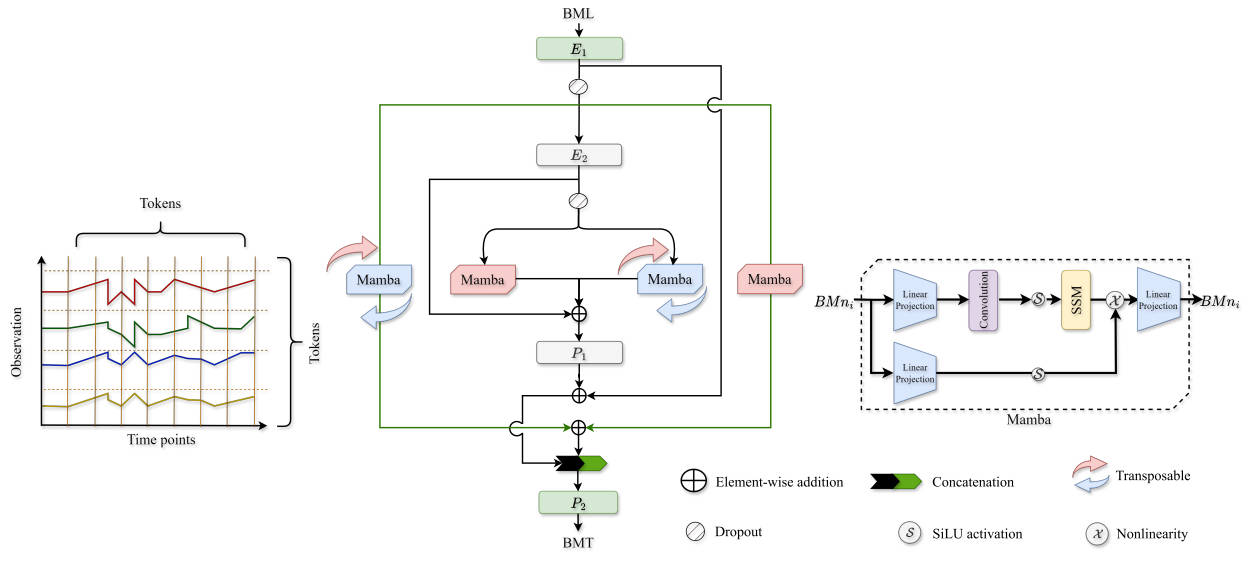
创新四Mamba集成架构,基于Mamba线性复杂度的选择性状态空间特性,同时提取多尺度全局+局部上下文,统一支持通道混合/独立两种处理模式,自适应不同通道规模的数据集
核心痛点
现有长期时序预测(LTSF)方法存在明显短板:Transformer类依赖自注意力,二次复杂度导致长序列训练推理内存开销极高,难以落地;线性/MLP类方法虽然高效,但长程时序依赖捕捉能力不足,精度受限;现有方案仅适配通道独立或通道混合单一场景,无法自适应不同数据集特性。
模块亮点
- 创新四Mamba集成架构,基于Mamba线性复杂度的选择性状态空间特性,同时提取多尺度全局+局部上下文,统一支持通道混合/独立两种处理模式,自适应不同通道规模的数据集;
- 性能拉满:在Weather、Traffic、Electricity等7个主流LTSF基准上,所有预测长度下精度全面超越iTransformer、PatchTST等最新SOTA,部分场景MSE降低超20%;
- 极高效:内存占用与轻量线性模型DLinear相当,参数量随输入序列长度线性增长,支持超长回看窗口,适配边缘部署场景。
适用场景
领域为时序分析,适配所有长期多变量时序预测任务(天气、交通、电力、能源、工业运维预测等),可直接替换现有LTSF pipeline的预测backbone,无需改动数据预处理逻辑。
插入位置建议
- 作为完整的预测backbone使用,输入接时序数据归一化层输出(张量形状为Batch×通道数×回看窗口长度),输出直接得到指定长度的预测序列,无需额外添加特征提取或预测头模块。
适用任务
- 时序分析
- 适配所有长期多变量时序预测任务(天气
- 交通
完整代码
tm.py
from mamba_ssm import Mamba
import torch
import torch.nn as nn

"""
由于捕获长期依赖性、实现线性可扩展性和保持计算效率的困难,长期时间序列预测仍然具有挑战性。
推出了TimeMachine,这是一种创新模型,它利用 Mamba(一种状态空间模型)来捕获多元时间序列数据中的长期依赖性,同时保持线性可扩展性和较小的内存占用。
TimeMachine 利用时间序列数据的独特属性来产生多尺度的显着上下文线索,并利用创新的集成四曼巴架构来统一对通道混合和通道独立情况的处理,从而能够有效地选择内容进行预测不同尺度的全球和地方背景。
在实验上,TimeMachine 在预测准确性、可扩展性和内存效率方面实现了卓越的性能,
"""


class RevIN(nn.Module):
    def __init__(self, num_features: int, eps=1e-5, affine=True):
        """
        :param num_features: the number of features or channels
        :param eps: a value added for numerical stability
        :param affine: if True, RevIN has learnable affine parameters
        """
        super(RevIN, self).__init__()
        self.num_features = num_features
        self.eps = eps
        self.affine = affine
        if self.affine:
            self._init_params()

    def forward(self, x, mode:str):
        if mode == 'norm':
            self._get_statistics(x)
            x = self._normalize(x)
        elif mode == 'denorm':
            x = self._denormalize(x)
        else: raise NotImplementedError
        return x

    def _init_params(self):
        # initialize RevIN params: (C,)
        self.affine_weight = nn.Parameter(torch.ones(self.num_features))
        self.affine_bias = nn.Parameter(torch.zeros(self.num_features))

    def _get_statistics(self, x):
        dim2reduce = tuple(range(1, x.ndim-1))
        self.mean = torch.mean(x, dim=dim2reduce, keepdim=True).detach()
        self.stdev = torch.sqrt(torch.var(x, dim=dim2reduce, keepdim=True, unbiased=False) + self.eps).detach()

    def _normalize(self, x):
        x = x - self.mean
        x = x / self.stdev
        if self.affine:
            x = x * self.affine_weight
            x = x + self.affine_bias
        return x

    def _denormalize(self, x):
        if self.affine:
            x = x - self.affine_bias
            x = x / (self.affine_weight + self.eps*self.eps)
        x = x * self.stdev
        x = x + self.mean
        return x


class Model(torch.nn.Module):
    def __init__(self, configs):
        super(Model, self).__init__()
        self.configs = configs
        if self.configs.revin == 1:
            self.revin_layer = RevIN(self.configs.enc_in)

        self.lin1 = torch.nn.Linear(self.configs.seq_len, self.configs.n1)
        self.dropout1 = torch.nn.Dropout(self.configs.dropout)

        self.lin2 = torch.nn.Linear(self.configs.n1, self.configs.n2)
        self.dropout2 = torch.nn.Dropout(self.configs.dropout)
        if self.configs.ch_ind == 1:
            self.d_model_param1 = 1
            self.d_model_param2 = 1

        else:
            self.d_model_param1 = self.configs.n2
            self.d_model_param2 = self.configs.n1

        self.mamba1 = Mamba(d_model=self.d_model_param1, d_state=self.configs.d_state, d_conv=self.configs.dconv,
                            expand=self.configs.e_fact)
        self.mamba2 = Mamba(d_model=self.configs.n2, d_state=self.configs.d_state, d_conv=self.configs.dconv,
                            expand=self.configs.e_fact)
        self.mamba3 = Mamba(d_model=self.configs.n1, d_state=self.configs.d_state, d_conv=self.configs.dconv,
                            expand=self.configs.e_fact)
        self.mamba4 = Mamba(d_model=self.d_model_param2, d_state=self.configs.d_state, d_conv=self.configs.dconv,
                            expand=self.configs.e_fact)

        self.lin3 = torch.nn.Linear(self.configs.n2, self.configs.n1)
        self.lin4 = torch.nn.Linear(2 * self.configs.n1, self.configs.pred_len)

    def forward(self, x):
        if self.configs.revin == 1:
            x = self.revin_layer(x, 'norm')
        else:
            means = x.mean(1, keepdim=True).detach()
            x = x - means
            stdev = torch.sqrt(torch.var(x, dim=1, keepdim=True, unbiased=False) + 1e-5)
            x /= stdev

        x = torch.permute(x, (0, 2, 1))
        if self.configs.ch_ind == 1:
            x = torch.reshape(x, (x.shape[0] * x.shape[1], 1, x.shape[2]))

        x = self.lin1(x)
        x_res1 = x
        x = self.dropout1(x)
        x3 = self.mamba3(x)
        if self.configs.ch_ind == 1:
            x4 = torch.permute(x, (0, 2, 1))
        else:
            x4 = x
        x4 = self.mamba4(x4)
        if self.configs.ch_ind == 1:
            x4 = torch.permute(x4, (0, 2, 1))

        x4 = x4 + x3

        x = self.lin2(x)
        x_res2 = x
        x = self.dropout2(x)

        if self.configs.ch_ind == 1:
            x1 = torch.permute(x, (0, 2, 1))
        else:
            x1 = x
        x1 = self.mamba1(x1)
        if self.configs.ch_ind == 1:
            x1 = torch.permute(x1, (0, 2, 1))

        x2 = self.mamba2(x)

        if self.configs.residual == 1:
            x = x1 + x_res2 + x2
        else:
            x = x1 + x2

        x = self.lin3(x)
        if self.configs.residual == 1:
            x = x + x_res1

        x = torch.cat([x, x4], dim=2)
        x = self.lin4(x)
        if self.configs.ch_ind == 1:
            x = torch.reshape(x, (-1, self.configs.enc_in, self.configs.pred_len))

        x = torch.permute(x, (0, 2, 1))
        if self.configs.revin == 1:
            x = self.revin_layer(x, 'denorm')
        else:
            x = x * (stdev[:, 0, :].unsqueeze(1).repeat(1, self.configs.pred_len, 1))
            x = x + (means[:, 0, :].unsqueeze(1).repeat(1, self.configs.pred_len, 1))

        return x

if __name__ == '__main__':
    # 假设的配置类
    class MockConfigs:
        def __init__(self):
            self.revin = 1
            self.enc_in = 10  # 假设输入特征的数量为 10
            self.seq_len = 30  # 假设序列长度为 30
            self.n1 = 64  # 第一个线性层的输出特征数
            self.n2 = 128  # 第二个线性层的输出特征数
            self.dropout = 0.1  # dropout 概率
            self.ch_ind = 1  # 假设的通道指数参数
            self.d_state = 32  # Mamba 参数
            self.dconv = 3  # 确保是在2到4之间
            self.e_fact = 2  # Mamba 参数
            self.pred_len = 30  # 假设预测长度为 5
            self.residual = 1  # 添加这行,启用残差连接


    # 实例化配置
    configs = MockConfigs()

    model = Model(configs)

    # 创建模拟输入张量
    # 假设批大小为 1,序列长度为 30,输入特征为 10
    input_tensor = torch.rand(1, configs.seq_len, configs.enc_in)

    # 将模型和张量移到 CUDA 上(如果可用)
    if torch.cuda.is_available():
        model.cuda()
        input_tensor = input_tensor.cuda()

    # 通过模型前向传播
    output = model(input_tensor)

    print("输入大小:", input_tensor.size())
    print("输出大小:", output.size())
环境与依赖
Python 3.9+
继续浏览
下一篇Trans-Adapter 透明双流适配把 RGB 与透明度两条潜特征流沿通道拼接,用投影和卷积残差块交换信息,再拆回双流结构;可以只更新透明度分支、让 RGB 分支保留参考信息。两条流处理的是潜空间特征,不是原始 RGBA 像素。相关资源
模块2026-11-20
EBCA 基于能量的交叉注意力
贝叶斯上下文更新:把每层交叉注意力建模成能量模型,推理时在线更新文本上下文并级联传给下一层
AIGC扩散模型文生图
深度学习MIT
模块2026-11-20
Wave-pooling 波叠加池化
车即波、相位管交互:每辆车编码成带振幅和相位的波,振幅由 Plain-FC 从 LSTM 隐状态学出,相位随运动状态动态变化,像波干涉一样调制车与车的信息聚合
自动驾驶轨迹预测WavePooling
深度学习MIT
模块2026-11-21
CARE-Q 误差补偿量化
用双路校准激活形成共享补偿表示,对角信号指导候选舍入,非对角信息执行双路传播。它属于离线逐列重建,不是推理时额外运行的修正模块。
大语言模型模型量化训练后量化
深度学习MIT