模块更新于 2026-11-20· 浏览 1· 下载 0
EBCA 基于能量的交叉注意力
贝叶斯上下文更新:把每层交叉注意力建模成能量模型,推理时在线更新文本上下文并级联传给下一层
结构图
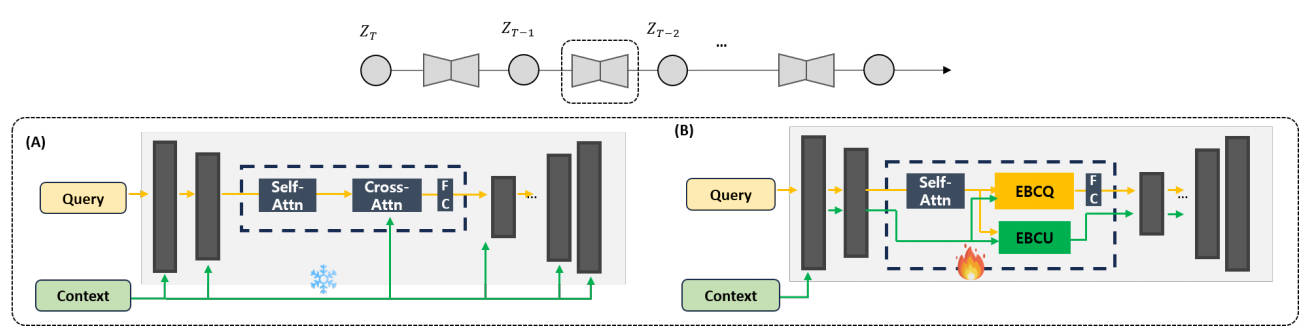
贝叶斯上下文更新:把每层交叉注意力建模成能量模型,推理时在线更新文本上下文并级联传给下一层
论文信息
- 论文:Energy-Based Cross Attention for Bayesian Context Update in Text-to-Image Diffusion Models
- 出处:NeurIPS 2023
核心痛点
文生图扩散模型(如 Stable Diffusion)用冻结的 CLIP 把提示词编码成固定上下文向量,原样喂给所有交叉注意力层,从不根据图像表征反过来修正上下文,导致多概念提示"灾难性忽视"、部分概念被漏画,文本引导修复也常填不进提示词内容。
模块亮点
- 贝叶斯上下文更新:把每层交叉注意力建模成能量模型,推理时在线更新文本上下文并级联传给下一层
- 零训练几乎零开销:梯度项只复用层内现成的 key、query 和注意力图,不引入额外计算成本,不改权重、不微调即可挂载到预训练模型
- 编辑涨点实打实:SD 挂上本模块后 Cat→Dog 的 CLIP 准确率 93.7%,高于 pix2pix-zero 的 92.4%;加眼镜任务 81.1% 对 71.2%;还支持零样本组合生成,负系数即概念否定
适用场景
领域为文生图扩散模型 / AIGC,原文在 Stable Diffusion 上验证了多概念生成、文本引导修复、图像编辑;可迁移到现成文生图模型的条件生成与编辑,如属性编辑、多提示词组合生成。
插入位置建议
- 替换 Stable Diffusion U-Net 各交叉注意力层的处理器(如 diffusers 的 Attention Processor),让文本嵌入边推理边更新
- 配合 DDIM 反演与 BLIP 自动描述,在真实图像编辑的去噪过程中启用 EBCU / EBCQ
- 接入 Stable-Repaint / Stable-Inpaint,用下采样修复掩码约束上下文更新,做文本引导修复
适用任务
- 文生图扩散模型
- AIGC
- 原文在 Stable Diffusion 上验证了多概念生成
完整代码
ebca.py
from math import sqrt
from typing import Optional, List
import torch
from diffusers.models.attention_processor import Attention


"""
尽管文本到图像扩散模型在图像生成任务中表现出色,但最近的研究提出了生成图像有时无法捕获文本提示的预期语义内容的问题,这种现象通常称为语义错位。
为了解决这个问题,我们在这里提出了一种新颖的基于能量的模型(EBM)框架,通过对上下文向量的后验进行建模来进行自适应上下文控制。
具体来说,我们首先在去噪自动编码器的每个交叉注意力层中制定潜在图像表示和文本嵌入的 EBM。然后,我们获得上下文向量的对数后验梯度,可以对其进行更新并转移到后续的交叉注意力层,从而隐式地最小化能量函数的嵌套层次结构。
我们的潜在 EBM 进一步允许零样本合成生成作为来自不同上下文的交叉注意输出的线性组合。
通过大量的实验,我们证明了所提出的方法在处理各种图像生成任务方面非常有效,包括多概念生成、文本引导图像修复以及真实和合成图像编辑。
"""


class EnergyCrossAttnProcessor:
    def __call__(
        self,
        attn: Attention,
        hidden_states,
        gamma_attn: float=0.,
        gamma_norm: float=0.,
        encoder_hidden_states=None,
        attention_mask=None,
        # For text-guided inpainting
        downsample_mask_fn=None,
        # For compositional editing
        alpha: List[float]=[0.],
        edit_prompt_embeds: Optional[List[torch.Tensor]]=None,
        editing_direction: List[int]=[False],
        gamma_attn_comp: List[float]=[0.,],
        gamma_norm_comp: List[float]=[0.,],
        # For token-wise gamma_attn tuning
        token_indices: Optional[List[int]]=None,
        token_upweight: Optional[List[float]]=None,
    ):
        """
        Energy-based Cross-Attention (EBCA) implementation.
        While the conventional cross-attention only takes hidden states (for q) and encoder_hidden_states (for k,v),
        the proposed EBCA takes hyper-parameters, editorial embeddings, etc, as additional inputs.
        Moreover, EBCA additionally returns C_main and C_edit which are update terms of main and editorial embeddings.
        Both C_main and C_edit are computed by Bayesian Context Update (BCU).
        These update terms are added to the original embeddings in energy_transformer.py.
        For CACAO, edit_prompt_embeds serve as additional editorial embeddings.

        [Introduced hyper-parameters]
        - gamma_attn, gamma_norm: Step sizes of BCU of main embedding
        - downsample_mask_fn: For text-guided inpainting. lambda function which takes the spatial resolution of the corresponding layer
            and returns the downsampled inpainting mask.
        - alpha: linear coefficient of CACAO
        - edit_prompt_embeds: list of editorial prompt embeddings
        - editing_direction: indicating conjunction/negation of compositional editing. +1: conjunction, else: negation
        - gamma_attn_comp, gamma_norm_comp: Step sizes of BCU of each editorial embedding
        - token_indices: indices of textual token for token-wise gamma_attn, e.g. [2,5] indicates
        2nd and 5th token.
        - token_upweight: increases i-th gamma_attn of main textual embedding following
        token_indices. Token-wise gamma_attn tuning is not applied to the gamma_attn_comp because
        edit_prompt_embeds are encoded from the whole editorial prompts.
        """
        # batch_size = 2*num_of_images_wewant_to_generate (due to cfg)
        batch_size, sequence_length, _ = hidden_states.shape
        N = batch_size // 2
        attention_mask = attn.prepare_attention_mask(attention_mask, sequence_length, batch_size)
        self_attention = False

        if encoder_hidden_states is None:
            self_attention = True
            encoder_hidden_states = hidden_states
        elif attn.norm_cross:
            encoder_hidden_states = attn.norm_encoder_hidden_states(encoder_hidden_states)

        output_state_temp, query, key, attention_scores = self.attend(hidden_states, encoder_hidden_states,
                                                                      attn, attention_mask)

        # ----------------------------------------------------------------------
        # For composition:
        # Additional editting for compositional generation
        # ----------------------------------------------------------------------
        if edit_prompt_embeds is not None and not self_attention:
            # C_edit: Bayesian context update for editorial embeddings
            output_state, C_edit = self.cacao(
                output_state_temp,
                edit_prompt_embeds,
                editing_direction,
                hidden_states,
                attn,
                attention_mask,
                N,
                alpha,
                gamma_attn_comp,
                gamma_norm_comp,
            )
        else:
            output_state = output_state_temp
            C_edit = []
        # ----------------------------------------------------------------------

        # C_main: Bayesian context update for main embeddings
        C_main = self.bayesian_context_update(
            attention_scores,
            query,
            key,
            gamma_attn,
            gamma_norm,
            attn,
            N,
            downsample_mask_fn=downsample_mask_fn,
            token_indices=token_indices,
            token_upweight=token_upweight
        )

        return output_state, C_main, C_edit, attention_scores

    def cacao(
        self,
        output_state_temp: torch.Tensor,
        edit_prompt_embeds: List[torch.Tensor],
        editing_direction: List[int],
        hidden_states: torch.Tensor,
        attn: Attention,
        attention_mask,
        N: int,
        alpha: List[float],
        gamma_attn_comp: List[float],
        gamma_norm_comp: List[float],
    ):
        C_edit = []

        # Let N=#number_of_images_wewant_to_generate. Then,
        # len(edit_prompt_embeds) = N + num_edit_prompt*N, where first N corresponds to the
        # unconditional embeds.
        num_edit_prompt = (len(edit_prompt_embeds) - N) // N
        assert len(alpha) == num_edit_prompt
        uncond_embed = edit_prompt_embeds[:N]
        edit_strength = 1.

        for i, edit_prompt_embed in enumerate(edit_prompt_embeds[N:].chunk(num_edit_prompt)):
            # 1. cross-attention map for each editorial context
            edit_prompt_embed_with_uncond = torch.cat((uncond_embed, edit_prompt_embed))
            output_state_edit, query_edit, key_edit, attention_scores_edit = \
                self.attend(hidden_states, edit_prompt_embed_with_uncond, attn, attention_mask)

            # 2. Bayesian context update for editorial embeddings
            # C_edit_i contains update term of both uncond. and cond. embeddings.
            C_edit_i = self.bayesian_context_update(
                attention_scores_edit,
                query_edit,
                key_edit,
                gamma_attn_comp[i],
                gamma_norm_comp[i],
                attn,
                N
            )
            C_edit.append(C_edit_i)

            sgn = 1. if editing_direction[i] == 1 else -1.
            output_state_temp = output_state_temp + sgn * alpha[i] * output_state_edit
            edit_strength += sgn * alpha[i]
        output_state = output_state_temp / edit_strength
        return output_state, C_edit

    def bayesian_context_update(
        self,
        attention_scores: torch.Tensor,
        query: torch.Tensor,
        key: torch.Tensor,
        gamma_attn: float,
        gamma_norm: float,
        attn: Attention,
        N: int,
        downsample_mask_fn=None,
        token_indices: Optional[List[int]]=None,
        token_upweight: Optional[List[float]]=None,
    ):
        # calculate att-prob for context
        # TODO: forward update of edit_prompt_embeds if exists
        attention_probs = attention_scores.mT.softmax(dim=-1)
        attention_probs = attention_probs.to(query.dtype)

        # ----------------------------------------------------------------------
        # For text-guided inpainting:
        # downsample_mask_fn: default: None
        # ----------------------------------------------------------------------
        if downsample_mask_fn is not None:
            query_spatial_dim = int(sqrt(query.shape[-2]))
            mask_ = downsample_mask_fn(query_spatial_dim).reshape(-1, 1)
            C = torch.bmm(attention_probs, (query*mask_))
        else:
            C = torch.bmm(attention_probs, query)
        C = attn.batch_to_head_dim(C) * gamma_attn

        # ----------------------------------------------------------------------
        # For token-wise gamma_attn tuning
        # ----------------------------------------------------------------------
        if token_indices is not None and token_upweight is not None:
            assert len(token_indices) == len(token_upweight), \
                "Upweighting hyper-parameter is not specified correctly."
            for i, ind in enumerate(token_indices):
                C[N:, ind, :] *= token_upweight[i]
        # ----------------------------------------------------------------------

        # norm
        k = attn.batch_to_head_dim(key)
        weight = torch.diagonal(torch.matmul(k, k.mT), dim1=-2, dim2=-1)
        C -= k * weight.softmax(dim=-1).unsqueeze(-1) * gamma_norm
        C  = torch.matmul(C, attn.to_k.weight.detach())

        # C: gradient term of the update rule
        return C

    def attend(self, input_state, context_embed, attn, attention_mask):
        query = attn.to_q(input_state)
        key = attn.to_k(context_embed)
        value = attn.to_v(context_embed)

        query = attn.head_to_batch_dim(query)
        key = attn.head_to_batch_dim(key)
        value = attn.head_to_batch_dim(value)

        if attn.upcast_attention:
            query = query.float()
            key = key.float()

        # Attention in diffusers==0.16.1 only uses attention_probs. Thus raw_attention_scores
        # are extracted with the below function.
        attention_scores = self.get_raw_attention_scores(query, key, attn, attention_mask)
        if attn.upcast_softmax:
            attention_scores = attention_scores.float()

        # calculate att-prob for value
        attention_probs = attention_scores.softmax(dim=-1)
        attention_probs = attention_probs.to(query.dtype)
        output_state = torch.bmm(attention_probs, value)
        output_state = attn.batch_to_head_dim(output_state)

        # linear proj
        output_state = attn.to_out[0](output_state)
        # dropout
        output_state = attn.to_out[1](output_state)
        return output_state, query, key, attention_scores

    def get_raw_attention_scores(self, query, key, attn, attention_mask=None):
        dtype = query.dtype

        if attention_mask is None:
            baddbmm_input = torch.empty(
                query.shape[0], query.shape[1], key.shape[1], dtype=query.dtype, device=query.device
            )
            beta = 0
        else:
            baddbmm_input = attention_mask
            beta = 1

        attention_scores = torch.baddbmm(
            baddbmm_input,
            query,
            key.transpose(-1, -2),
            beta=beta,
            alpha=attn.scale,
        )

        if attn.upcast_softmax:
            attention_scores = attention_scores.float()
        return attention_scores

class EnergyCrossAttention(Attention):
    def __init__(
            self,
            query_dim: int,
            cross_attention_dim: Optional[int] = None,
            heads: int = 8,
            dim_head: int = 64,
            dropout: float = 0.0,
            bias=False,
            upcast_attention: bool = False,
            upcast_softmax: bool = False,
            cross_attention_norm: Optional[str] = None,
            cross_attention_norm_num_groups: int = 32,
            added_kv_proj_dim: Optional[int] = None,
            norm_num_groups: Optional[int] = None,
            out_bias: bool = True,
            scale_qk: bool = True,
            only_cross_attention: bool = False,
            processor=EnergyCrossAttnProcessor,
        ):
        super().__init__(query_dim=query_dim,
                         cross_attention_dim=cross_attention_dim,
                         heads=heads,
                         dim_head=dim_head,
                         dropout=dropout,
                         bias=bias,
                         upcast_attention=upcast_attention,
                         upcast_softmax=upcast_softmax,
                         cross_attention_norm=cross_attention_norm,
                         cross_attention_norm_num_groups=cross_attention_norm_num_groups,
                         added_kv_proj_dim=added_kv_proj_dim,
                         norm_num_groups=norm_num_groups,
                         out_bias=out_bias,
                         scale_qk=scale_qk,
                         only_cross_attention=only_cross_attention,
                         processor=processor()
                    )

    def forward(self, hidden_states, encoder_hidden_states=None, attention_mask=None, **cross_attention_kwargs):
        # We pass hyperparams (e.g., gammas) with `**cross_attention_kwargs`
        return self.processor(
            self,
            hidden_states,
            encoder_hidden_states=encoder_hidden_states,
            attention_mask=attention_mask,
            **cross_attention_kwargs,
        )


if __name__ == '__main__':
    # 假定的输入参数尺寸
    batch_size = 2
    seq_length = 16  # 序列长度
    hidden_dim = 512  # 隐藏状态维度

    # 创建隐藏状态和编码器隐藏状态的模拟输入
    hidden_states = torch.randn(batch_size, seq_length, hidden_dim)
    encoder_hidden_states = torch.randn(batch_size, seq_length, hidden_dim)

    # 可选的注意力掩码
    attention_mask = torch.ones(batch_size, seq_length)

    # 初始化 EnergyCrossAttention 模块
    energy_cross_attention = EnergyCrossAttention(query_dim=hidden_dim,
        cross_attention_dim=hidden_dim,  # 假设 query 和 cross attention 的维度相同
        heads=8,
        dim_head=64,
        dropout=0.1,
    )

    # 调用 EnergyCrossAttention 模块
    output, C_main, C_edit, attention_scores = energy_cross_attention(hidden_states=hidden_states, encoder_hidden_states=encoder_hidden_states, attention_mask=attention_mask,)

    print("输出大小:", output.size())
环境与依赖
Python 3.9+
继续浏览
下一篇EBlock 低光增强编码块空间频域双管齐下:沿用 Metaformer / NAFBlock 式"注意力 + FFN"结构,前半 SpAM 用倒残差、SimpleGate 门控和简化通道注意力(SCA)做空间特征提纯,相关资源
模块2026-11-20
HOIST 人-物交互空间Transformer
三元组标记化:把每组〈主体、动作、客体〉连同边界框编成三个 token,主体/客体用 CLIP 文本嵌入加傅里叶框嵌入融合,动作走单独 MLP;再用实例嵌入聚组、角色嵌入分角色,多组交互同框也能分清谁在对谁做什么
AIGC文生图扩散模型
计算机视觉MIT
模块2026-11-20
Wave-pooling 波叠加池化
车即波、相位管交互:每辆车编码成带振幅和相位的波,振幅由 Plain-FC 从 LSTM 隐状态学出,相位随运动状态动态变化,像波干涉一样调制车与车的信息聚合
自动驾驶轨迹预测WavePooling
深度学习MIT
模块2026-11-21
CARE-Q 误差补偿量化
用双路校准激活形成共享补偿表示,对角信号指导候选舍入,非对角信息执行双路传播。它属于离线逐列重建,不是推理时额外运行的修正模块。
大语言模型模型量化训练后量化
深度学习MIT