模块更新于 2026-11-20· 浏览 2· 下载 0
TIAM 时空交互注意力模块
时空双重交互:对双时相特征构建 Gram 矩阵,同时查询空间透视依赖与时间风格相关性,沿时间、空间两维加权重建特征后残差输出,一次前向对抗视角旋转与风格差异
结构图
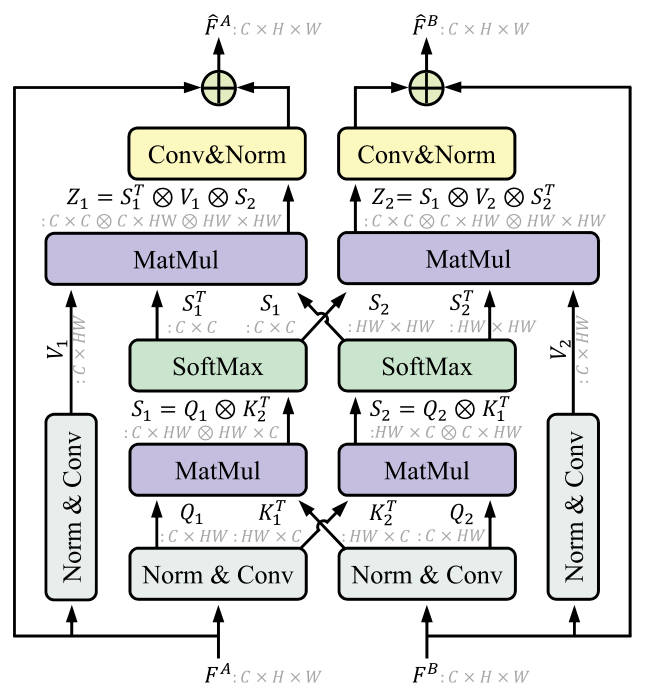
时空双重交互:对双时相特征构建 Gram 矩阵,同时查询空间透视依赖与时间风格相关性,沿时间、空间两维加权重建特征后残差输出,一次前向对抗视角旋转与风格差异
论文信息
- 论文:Robust change detection for remote sensing images based on temporospatial interactive attention module
- 出处:International Journal of Applied Earth Observation and Geoinformation 2024
核心痛点
双时相遥感影像常因视角不同产生几何透视旋转、因光照天气季节产生时间风格差异,这些“伪变化”带来大量误检;主流交互方法中,自注意力忽略时相内部相似性,交叉注意力只建模空间依赖,交互不充分且计算冗余。
模块亮点
- 时空双重交互:对双时相特征构建 Gram 矩阵,同时查询空间透视依赖与时间风格相关性,沿时间、空间两维加权重建特征后残差输出,一次前向对抗视角旋转与风格差异
- 消融优势明显:同一 CDNeXt 骨架下 TIAM 在 SYSU-CD(F1 82.63%)与 S2Looking(66.71%)上均优于五种主流注意力,比无注意力基线分别提升 1.12、1.54
- 即插即用省算力:嵌入 IFNet 等主流网络同样涨点,BANDON 上 F1 从 59.24 升至 69.13;交互在 1/4 尺寸特征图上完成,参数量与 FLOPs 几乎不涨
适用场景
领域为遥感影像变化检测;原文在 SYSU-CD、LEVIR-CD+、S2Looking、BANDON 四个基准上验证;凡是要表达“两份特征相似度”的任务都可迁移,如视频变化检测、医学影像随访对比。
插入位置建议
- 孪生网络两分支同尺度特征之后、拼接 / 差分 / 解码之前,替换原有交互层
- 嵌进 IFNet 等现成变化检测网络的解码器入口,原文插入后均涨点
- 放在金字塔逐级交互,再与解码器上采样特征跳连融合
适用任务
- 遥感影像变化检测
完整代码
tiam.py
import torch
import torch.nn as nn
import torch.nn.functional as F

"""Elsevier2024
变化检测 (CD) 是地球观测中一种重要的监测方法,尤其适用于土地利用分析、城市管理和灾害损失评估。然而,在星座互联和空天协作时代,感兴趣区域 (ROI) 的变化由于几何透视旋转和时间风格差异而导致许多错误检测。
为了应对这些挑战,我们引入了 CDNeXt,该框架阐明了一种稳健而有效的方法,用于将基于预训练主干的 Siamese 网络与用于遥感图像的创新时空交互注意模块 (TIAM) 相结合。
CDNeXt 可分为四个主要组件:编码器、交互器、解码器和检测器。值得注意的是,由 TIAM 提供支持的交互器从编码器提取的二进制时间特征中查询和重建空间透视依赖关系和时间风格相关性,以扩大 ROI 变化的差异。
最后,检测器集成解码器生成的分层特征,随后生成二进制变化掩码。
"""

class SpatiotemporalAttentionFullNotWeightShared(nn.Module):
    def __init__(self, in_channels, inter_channels=None, dimension=2, sub_sample=False):
        super(SpatiotemporalAttentionFullNotWeightShared, self).__init__()
        assert dimension in [2, ]
        self.dimension = dimension
        self.sub_sample = sub_sample
        self.in_channels = in_channels
        self.inter_channels = inter_channels

        if self.inter_channels is None:
            self.inter_channels = in_channels // 2
            if self.inter_channels == 0:
                self.inter_channels = 1

        self.g1 = nn.Sequential(
            nn.BatchNorm2d(self.in_channels),
            nn.Conv2d(in_channels=self.in_channels, out_channels=self.inter_channels,
                      kernel_size=1, stride=1, padding=0)
        )
        self.g2 = nn.Sequential(
            nn.BatchNorm2d(self.in_channels),
            nn.Conv2d(in_channels=self.in_channels, out_channels=self.inter_channels,
                      kernel_size=1, stride=1, padding=0),
        )

        self.W1 = nn.Sequential(
            nn.Conv2d(in_channels=self.inter_channels, out_channels=self.in_channels,
                      kernel_size=1, stride=1, padding=0),
            nn.BatchNorm2d(self.in_channels)
        )
        self.W2 = nn.Sequential(
            nn.Conv2d(in_channels=self.inter_channels, out_channels=self.in_channels,
                      kernel_size=1, stride=1, padding=0),
            nn.BatchNorm2d(self.in_channels)
        )
        self.theta = nn.Sequential(
            nn.BatchNorm2d(self.in_channels),
            nn.Conv2d(in_channels=self.in_channels, out_channels=self.inter_channels,
                      kernel_size=1, stride=1, padding=0),
        )
        self.phi = nn.Sequential(
            nn.BatchNorm2d(self.in_channels),
            nn.Conv2d(in_channels=self.in_channels, out_channels=self.inter_channels,
                      kernel_size=1, stride=1, padding=0),
        )

    def forward(self, x1, x2):
        """
        :param x: (b, c, h, w)
        :param return_nl_map: if True return z, nl_map, else only return z.
        :return:
        """
        batch_size = x1.size(0)
        g_x11 = self.g1(x1).reshape(batch_size, self.inter_channels, -1)
        g_x12 = g_x11.permute(0, 2, 1)
        g_x21 = self.g2(x2).reshape(batch_size, self.inter_channels, -1)
        g_x22 = g_x21.permute(0, 2, 1)

        theta_x1 = self.theta(x1).reshape(batch_size, self.inter_channels, -1)
        theta_x2 = theta_x1.permute(0, 2, 1)

        phi_x1 = self.phi(x2).reshape(batch_size, self.inter_channels, -1)
        phi_x2 = phi_x1.permute(0, 2, 1)

        energy_time_1 = torch.matmul(theta_x1, phi_x2)
        energy_time_2 = energy_time_1.permute(0, 2, 1)
        energy_space_1 = torch.matmul(theta_x2, phi_x1)
        energy_space_2 = energy_space_1.permute(0, 2, 1)

        energy_time_1s = F.softmax(energy_time_1, dim=-1)
        energy_time_2s = F.softmax(energy_time_2, dim=-1)
        energy_space_2s = F.softmax(energy_space_1, dim=-2)
        energy_space_1s = F.softmax(energy_space_2, dim=-2)
        #  C1*S(C2) energy_time_1s * C1*H1W1 g_x12 * energy_space_1s S(H2W2)*H1W1 -> C1*H1W1
        y1 = torch.matmul(torch.matmul(energy_time_2s, g_x11), energy_space_2s).contiguous()  # C2*H2W2
        #  C2*S(C1) energy_time_2s * C2*H2W2 g_x21 * energy_space_2s S(H1W1)*H2W2 -> C2*H2W2
        y2 = torch.matmul(torch.matmul(energy_time_1s, g_x21), energy_space_1s).contiguous()  # C1*H1W1
        y1 = y1.reshape(batch_size, self.inter_channels, *x2.size()[2:])
        y2 = y2.reshape(batch_size, self.inter_channels, *x1.size()[2:])
        return x1 + self.W1(y1), x2 + self.W2(y2)


if __name__ == '__main__':
    in_channels = 64
    batch_size = 8
    height = 32
    width = 32

    block = SpatiotemporalAttentionFullNotWeightShared(in_channels=in_channels)

    input1 = torch.rand(batch_size, in_channels, height, width)
    input2 = torch.rand(batch_size, in_channels, height, width)

    output1, output2 = block(input1, input2)

    print(f"Input1 size: {input1.size()}")
    print(f"Input2 size: {input2.size()}")
    print(f"Output1 size: {output1.size()}")
    print(f"Output2 size: {output2.size()}")
环境与依赖
Python 3.9+
继续浏览
下一篇TKSA Top-K稀疏注意力可学习Top-K选择:相似度矩阵每行只保留贡献最大的 K 个注意力分数、其余置零后再 softmax;K 不靠手工设定,而是对多个比例(1/2~4/5)加权平均动态学出相关资源
模块2026-11-20
LCGA 局部曲率引导注意力
曲率先验进注意力:可学习 3×3 深度卷积提取局部微分样响应,归一化成曲率图,再乘性调制窗口注意力 logits(1+α·曲率),曲率大处注意力自动增强
遥感图像超分辨率LCGA
计算机视觉MIT
模块2026-11-20
MSC 多尺度稀疏交叉注意力
多尺度线索抓全:对低层特征并行做 3、5、7 三种窗口的平均池化后相加,小窗口保纹理细节、大窗口抓整体结构
遥感图像场景分类MSC
计算机视觉MIT
模块2026-11-20
AGCA 自适应图通道注意力
把图卷积搬进通道注意力:每个通道当作一个图节点,用"单位矩阵 + 自注意力对角矩阵 + 可学习邻接矩阵"三张图自适应建模通道间关系,在特征层面做非局部操作,避开逐像素计算
目标检测缺陷检测AGCA
计算机视觉MIT