模块更新于 2026-11-20· 浏览 0· 下载 0
TAdaConv 时间自适应卷积
逐帧校准卷积核:把第 t 帧卷积核因式分解为 Wt = αt · Wb,基权重 Wb 全帧共享、可学习,校准系数 αt 自适应生成,让 2D 卷积原地获得时序建模能力
结构图
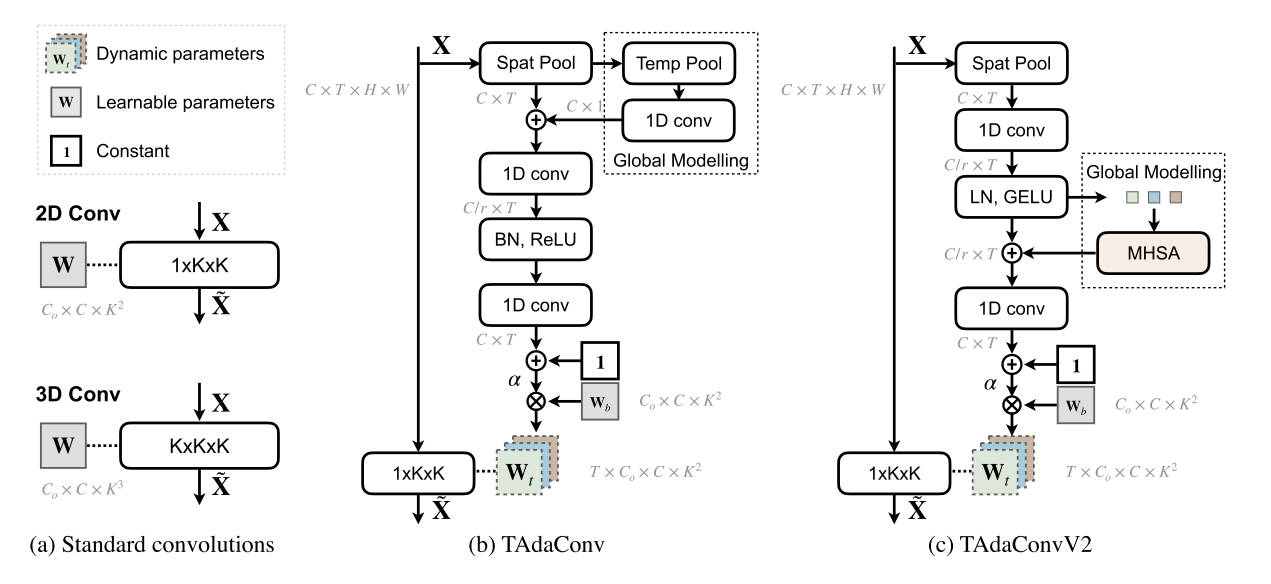
逐帧校准卷积核:把第 t 帧卷积核因式分解为 Wt = αt · Wb,基权重 Wb 全帧共享、可学习,校准系数 αt 自适应生成,让 2D 卷积原地获得时序建模能力
论文信息
- 论文:Temporally-Adaptive Models for Efficient Video Understanding
- 出处:arXiv 2023
核心痛点
视频模型的空间卷积默认时空不变,所有帧共享同一套卷积核,抓不住帧间细粒度时序动态;3D 卷积或 2D 卷积后串 1D 时序卷积开销不小;现有动态滤波又大多用不上预训练权重,且只看空间上下文或全局描述子,捕捉不了帧间变化。
模块亮点
- 逐帧校准卷积核:把第 t 帧卷积核因式分解为 Wt = αt · Wb,基权重 Wb 全帧共享、可学习,校准系数 αt 自适应生成,让 2D 卷积原地获得时序建模能力
- 即插即用涨点稳:替换 SlowOnly、SlowFast、R(2+1)D、R3D 等模型的卷积,K400 平均提升 1.3%、SSV2 平均提升 2.8%,额外开销不到 0.02 GFLOPs
- 白嫖预训练权重:校准生成函数末层零初始化并加常数 1,初始状态与标准卷积等价,ImageNet 预训练权重直接加载
适用场景
领域为视频理解 / 动作识别,原文在 K400、SSV1/V2、EK100 上做动作分类,HACS、EK100 上做时序动作定位;可迁移到视频检索、视频目标检测与分割等需补时序建模的任务。
插入位置建议
- 直接替换 ResNet 残差块里的 2D 卷积组成 TAda2D 块,越靠后的 stage 收益越大
- 把 ConvNeXt 块里的深度卷积换成深度 TAdaConvV2(对 Cout 维度校准),配 T-Pool 做时序特征聚合
- 在 ViT 每个多头自注意力前插入 TAdaBlock:两层 1×1 卷积夹一个深度 TAdaConvV2,即原文的 TAdaFormer
适用任务
- 视频理解
- 动作识别
- 原文在 K400
完整代码
tadaconv.py
#!/usr/bin/env python3
# Copyright (C) Alibaba Group Holding Limited.

""" TAdaConv.

空间卷积广泛用于许多深度视频模型中。它从根本上假设时空不变性,即对不同帧中的每个位置使用共享权重。
用于视频理解的时间自适应卷积(TAdaConv),表明沿时间维度的自适应权重校准是促进视频中复杂时间动态建模的有效方法。
具体来说,TAdaConv通过根据每个帧的局部和全局时间上下文校准其卷积权重,从而赋予空间卷积以时间建模能力。与现有的时间建模操作相比,
TAdaConv的效率更高,因为它在卷积核上操作,而不是在要素上操作,其维度比空间分辨率小一个数量级。此外,内核校准带来了更大的模型容量。
"""

import math
import torch
import torch.nn as nn
import torch.nn.functional as F
from torch.nn.modules.utils import _triple

class TAdaConv2d(nn.Module):
    """
    Performs temporally adaptive 2D convolution.
    Currently, only application on 5D tensors is supported, which makes TAdaConv2d
        essentially a 3D convolution with temporal kernel size of 1.
    """

    def __init__(self, in_channels, out_channels, kernel_size,
                 stride=1, padding=0, dilation=1, groups=1, bias=True,
                 cal_dim="cin"):
        super(TAdaConv2d, self).__init__()
        """
        Args:
            in_channels (int): number of input channels.
            out_channels (int): number of output channels.
            kernel_size (list): kernel size of TAdaConv2d.
            stride (list): stride for the convolution in TAdaConv2d.
            padding (list): padding for the convolution in TAdaConv2d.
            dilation (list): dilation of the convolution in TAdaConv2d.
            groups (int): number of groups for TAdaConv2d.
            bias (bool): whether to use bias in TAdaConv2d.
        """

        kernel_size = _triple(kernel_size)
        stride = _triple(stride)
        padding = _triple(padding)
        dilation = _triple(dilation)

        assert kernel_size[0] == 1
        assert stride[0] == 1
        assert padding[0] == 0
        assert dilation[0] == 1
        assert cal_dim in ["cin", "cout"]

        self.in_channels = in_channels
        self.out_channels = out_channels
        self.kernel_size = kernel_size
        self.stride = stride
        self.padding = padding
        self.dilation = dilation
        self.groups = groups
        self.cal_dim = cal_dim

        # base weights (W_b)
        self.weight = nn.Parameter(
            torch.Tensor(1, 1, out_channels, in_channels // groups, kernel_size[1], kernel_size[2])
        )
        if bias:
            self.bias = nn.Parameter(torch.Tensor(1, 1, out_channels))
        else:
            self.register_parameter('bias', None)

        nn.init.kaiming_uniform_(self.weight, a=math.sqrt(5))
        if self.bias is not None:
            fan_in, _ = nn.init._calculate_fan_in_and_fan_out(self.weight)
            bound = 1 / math.sqrt(fan_in)
            nn.init.uniform_(self.bias, -bound, bound)

    def forward(self, x, alpha):
        """
        Args:
            x (tensor): feature to perform convolution on.
            alpha (tensor): calibration weight for the base weights.
                W_t = alpha_t * W_b
        """
        _, _, c_out, c_in, kh, kw = self.weight.size()
        b, c_in, t, h, w = x.size()
        x = x.permute(0,2,1,3,4).reshape(1,-1,h,w)

        if self.cal_dim == "cin":
            # w_alpha: B, C, T, H(1), W(1) -> B, T, C, H(1), W(1) -> B, T, 1, C, H(1), W(1)
            # corresponding to calibrating the input channel
            weight = (alpha.permute(0,2,1,3,4).unsqueeze(2) * self.weight).reshape(-1, c_in//self.groups, kh, kw)
        elif self.cal_dim == "cout":
            # w_alpha: B, C, T, H(1), W(1) -> B, T, C, H(1), W(1) -> B, T, C, 1, H(1), W(1)
            # corresponding to calibrating the input channel
            weight = (alpha.permute(0,2,1,3,4).unsqueeze(3) * self.weight).reshape(-1, c_in//self.groups, kh, kw)

        bias = None
        if self.bias is not None:
            # in the official implementation of TAda2D,
            # there is no bias term in the convs
            # hence the performance with bias is not validated
            bias = self.bias.repeat(b, t, 1).reshape(-1)
        output = F.conv2d(
            x, weight=weight, bias=bias, stride=self.stride[1:], padding=self.padding[1:],
            dilation=self.dilation[1:], groups=self.groups * b * t)

        output = output.view(b, t, c_out, output.size(-2), output.size(-1)).permute(0,2,1,3,4)

        return output

    def __repr__(self):
        return f"TAdaConv2d({self.in_channels}, {self.out_channels}, kernel_size={self.kernel_size}, " +\
            f"stride={self.stride}, padding={self.padding}, bias={self.bias is not None}, cal_dim=\"{self.cal_dim}\")"


if __name__ == '__main__':
    # 创建TAdaConv2d实例
    tada_conv2d = TAdaConv2d(in_channels=64, out_channels=64, kernel_size=[1, 3, 3], stride=[1, 1, 1], padding=[0, 1, 1])

    # 生成随机输入张量,形状为(batch_size, channels, depth, height, width)
    input_tensor = torch.rand(2, 64, 10, 32, 32)  # 例如,批量大小为2,时间深度为10,高和宽为32

    # 生成alpha张量,形状根据cal_dim参数来定,这里我们假设其形状和输入形状相关
    # 如果cal_dim="cin",则alpha形状应该与输入通道数相对应
    # 如果cal_dim="cout",则alpha形状应该与输出通道数相对应
    alpha_tensor = torch.rand(2, 64, 10, 1, 1)  # 随机生成校准权重

    # 使用TAdaConv2d实例处理输入
    output_tensor = tada_conv2d(input_tensor, alpha_tensor)

    # 打印输入和输出张量的形状
    print(f"Input tensor shape: {input_tensor.shape}")
    print(f"Output tensor shape: {output_tensor.shape}")
环境与依赖
Python 3.9+
继续浏览
下一篇tAPE 时间绝对位置编码把长度写进频率:将序列长度 L 与嵌入维度 d_model 一并编入频率项(按 d_model/L 缩放),低维下位置内积随距离平滑单调变化,找回距离感知、缓解各向异性相关资源
模块2026-11-20
D2ST-Adapter 解耦可变形时空适配器
双路径解耦编码:瓶颈结构下采样后分空间、时序两条路径并行适配,空间抓外观语义、时序学动态变化,融合后上采样,保持单流结构
计算机视觉动作识别D2STAdapter
计算机视觉MIT
模块2026-11-20
HgC 沙漏卷积
沙漏形感受野:按时间偏移量决定各时间戳的空间核大小(p·|i|+1),离锚定帧越远感受野越大,专治大位移线索错位
计算机视觉视频理解HgC
计算机视觉MIT
模块2026-11-20
AFW 自适应帧加权模块
按质量给帧打分:对每一帧特征估计"帧质量",经 Softmax 得到权重,动态突出信息量大的帧、压低模糊 / 遮挡帧
计算机视觉姿态估计AFW
计算机视觉MIT