模块更新于 2026-11-20· 浏览 1· 下载 0
SHIP 协同高阶交互范式
频域等价变换:借卷积定理把空间域相关运算搬进频域,FFT 后逐元素相乘再逆变换,与全局交互数学等价、计算轻量
结构图
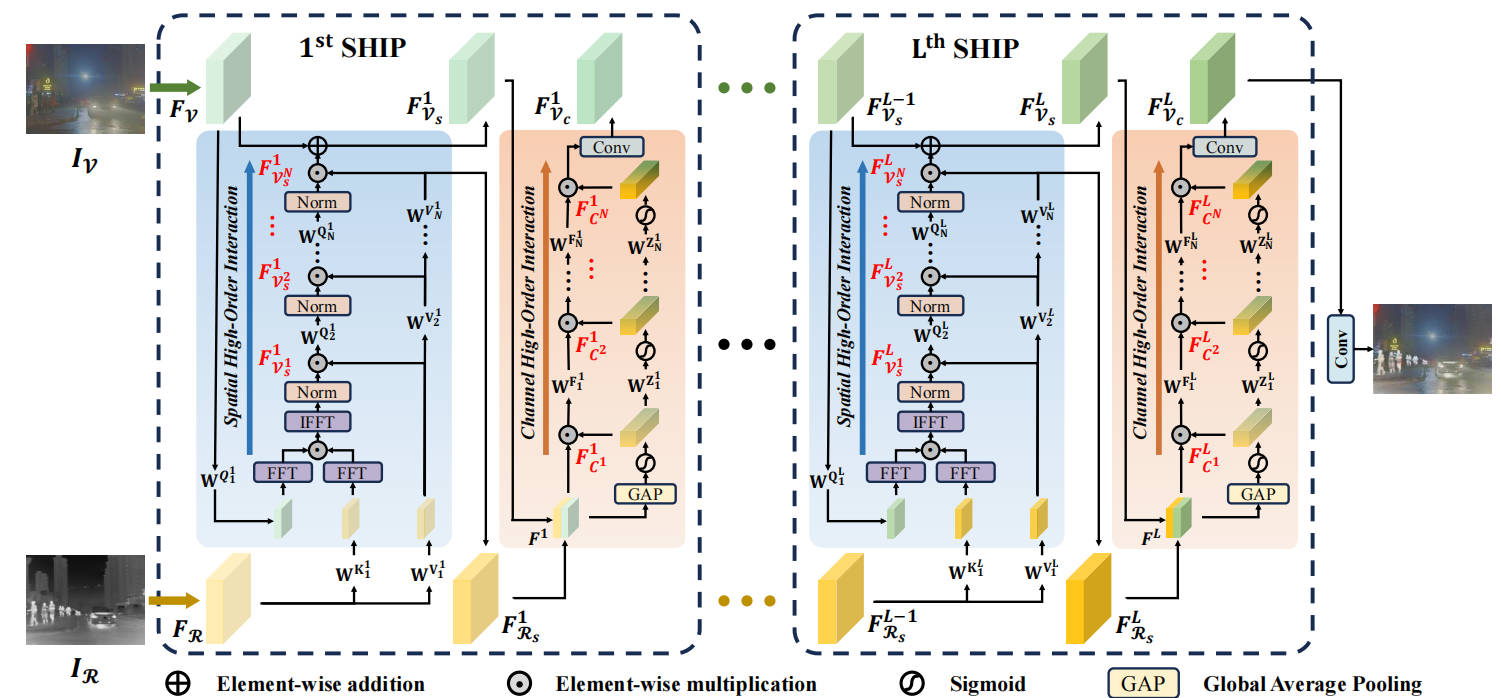
频域等价变换:借卷积定理把空间域相关运算搬进频域,FFT 后逐元素相乘再逆变换,与全局交互数学等价、计算轻量
论文信息
- 论文:Probing Synergistic High-Order Interaction in Infrared and Visible Image Fusion
- 出处:CVPR 2024
核心痛点
红外与可见光融合里,交叉注意力的 Q、K 点积本质上只捕捉二阶空间交互,空间与通道维度的高阶交互全被忽略,多模态协同效应挖不透;级联堆叠自注意力也只是重复二阶交互,还要背上矩阵乘法的巨额计算开销。
模块亮点
- 频域等价变换:借卷积定理把空间域相关运算搬进频域,FFT 后逐元素相乘再逆变换,与全局交互数学等价、计算轻量
- 双维度高阶建模:空间维度逐阶迭代聚合互补信息,构建 N 阶空间交互;通道维度把 SE 基于一阶统计量(均值)的交互扩展为高阶通道交互,分辨模态间依赖
- 涨点实打实:M3FD、RoadScene、TNO 三个基准上全面超过 9 个 SOTA 方法,M3FD 上 MI 4.813、VIF 0.922 均为最高;性能随阶数 N 升至 5 阶后趋稳(默认 N=5);扩展到全色锐化,GaoFen2 上 PSNR 47.458,比 INNformer 高 0.105 dB
适用场景
领域为红外与可见光图像融合,验证了 M3FD、RoadScene、TNO 三个基准,并扩展到全色锐化;可迁移到多聚焦融合、曝光融合、医学影像融合等双分支特征交互任务。
插入位置建议
- 替换红外-可见光融合网络中的交叉注意力融合层,双模态特征进、融合特征出
- 接在双分支特征提取之后、重建解码之前,堆叠多个 SHIP 块(原文默认 3 块)
- 放进全色锐化等双模态融合网络,替换 PAN 与多光谱特征的原有融合模块
适用任务
- 红外与可见光图像融合
- 验证了 M3FD
- RoadScene
完整代码
ship.py
import warnings
warnings.filterwarnings("ignore")
import torch.nn.init as init
import numbers
from einops import rearrange
import torch
import torch.nn as nn
import torch.nn.functional as F
import math
from torch.nn import Parameter
"""《Probing Synergistic High-Order Interaction in Infrared and Visible ImageFusion》 CVPR 2024
红外与可见光图像融合旨在通过整合和区分来自多个源的互补信息来生成融合图像。虽然具有全局空间交互的交叉注意力机制看似前景光明,但它仅能捕捉二阶空间交互,而忽略了空间和通道维度上的高阶交互。
这一局限性阻碍了多模态图像协同效应的发挥。为了弥合这一差距,我们引入了一种协同高阶交互范式 (Synergistic High-order Interaction Paradigm,SHIP),旨在系统地研究红外与可见光图像在两个基本维度上的空间细粒度和全局统计协作:
1) 空间维度:我们通过数学上等同于全局交互的元素乘法构建空间细粒度交互,然后通过迭代聚合和演化互补信息来构建高阶格式,从而提高效率和灵活性。
2) 通道维度:在具有一阶统计量(平均值)的通道交互基础上,我们设计了高阶通道交互,以便于基于全局统计量识别源图像之间的相互依赖关系。
利用高阶交互显著增强了我们的模型利用多模式协同作用的能力,从而通过在各种基准上的综合实验证明了其优于最先进的替代方案的性能。
"""
class Conv2d_Hori_Veri_Cross(nn.Module):
def __init__(self, in_channels, out_channels, kernel_size=3, stride=1,
padding=1, dilation=1, groups=1, bias=False, theta=0.7):
super(Conv2d_Hori_Veri_Cross, self).__init__()
self.conv = nn.Conv2d(in_channels, out_channels, kernel_size=(1, 5), stride=stride, padding=padding,
dilation=dilation, groups=groups, bias=bias)
self.theta = theta
def forward(self, x):
[C_out, C_in, H_k, W_k] = self.conv.weight.shape
tensor_zeros = torch.FloatTensor(C_out, C_in, 1).fill_(0).cuda()
conv_weight = torch.cat((tensor_zeros, self.conv.weight[:, :, :, 0], tensor_zeros, self.conv.weight[:, :, :, 1],
self.conv.weight[:, :, :, 2], self.conv.weight[:, :, :, 3], tensor_zeros,
self.conv.weight[:, :, :, 4], tensor_zeros), 2)
conv_weight = conv_weight.contiguous().view(C_out, C_in, 3, 3)
out_normal = F.conv2d(input=x, weight=conv_weight, bias=self.conv.bias, stride=self.conv.stride,
padding=self.conv.padding)
if math.fabs(self.theta - 0.0) < 1e-8:
return out_normal
else:
# pdb.set_trace()
[C_out, C_in, kernel_size, kernel_size] = self.conv.weight.shape
kernel_diff = self.conv.weight.sum(2).sum(2)
kernel_diff = kernel_diff[:, :, None, None]
out_diff = F.conv2d(input=x, weight=kernel_diff, bias=self.conv.bias, stride=self.conv.stride, padding=0,
groups=self.conv.groups)
return out_normal - self.theta * out_diff
class Conv2d_Diag_Cross(nn.Module):
def __init__(self, in_channels, out_channels, kernel_size=3, stride=1,
padding=1, dilation=1, groups=1, bias=False, theta=0.7):
super(Conv2d_Diag_Cross, self).__init__()
self.conv = nn.Conv2d(in_channels, out_channels, kernel_size=(1, 5), stride=stride, padding=padding,
dilation=dilation, groups=groups, bias=bias)
self.theta = theta
def forward(self, x):
[C_out, C_in, H_k, W_k] = self.conv.weight.shape
tensor_zeros = torch.FloatTensor(C_out, C_in, 1).fill_(0).cuda()
conv_weight = torch.cat((self.conv.weight[:, :, :, 0], tensor_zeros, self.conv.weight[:, :, :, 1], tensor_zeros,
self.conv.weight[:, :, :, 2], tensor_zeros, self.conv.weight[:, :, :, 3], tensor_zeros,
self.conv.weight[:, :, :, 4]), 2)
conv_weight = conv_weight.contiguous().view(C_out, C_in, 3, 3)
out_normal = F.conv2d(input=x, weight=conv_weight, bias=self.conv.bias, stride=self.conv.stride,
padding=self.conv.padding)
if math.fabs(self.theta - 0.0) < 1e-8:
return out_normal
else:
# pdb.set_trace()
[C_out, C_in, kernel_size, kernel_size] = self.conv.weight.shape
kernel_diff = self.conv.weight.sum(2).sum(2)
kernel_diff = kernel_diff[:, :, None, None]
out_diff = F.conv2d(input=x, weight=kernel_diff, bias=self.conv.bias, stride=self.conv.stride, padding=0,
groups=self.conv.groups)
return out_normal - self.theta * out_diff
def default_conv(in_channels, out_channels, kernel_size,stride=1, bias=True):
return nn.Conv2d(
in_channels, out_channels, kernel_size,
padding=(kernel_size//2),stride=stride, bias=bias)
class cdcconv(nn.Module):
def __init__(self, in_channels, out_channels, theta=0.8):
super(cdcconv, self).__init__()
self.h_conv = Conv2d_Hori_Veri_Cross(in_channels=in_channels, out_channels=out_channels, kernel_size=3, stride=1, padding=1, bias=False, theta=theta)
self.d_conv = Conv2d_Diag_Cross(in_channels=in_channels, out_channels=out_channels, kernel_size=3, stride=1, padding=1, bias=False, theta=theta)
self.HP_branch = Parameter(torch.FloatTensor(1))
def forward(self, x):
out1 = self.h_conv(x)
out2 = self.d_conv(x)
out = torch.sigmoid(self.HP_branch) * out1 + (1 - torch.sigmoid(self.HP_branch)) * out2 + x
# out = out1 + out2
return out
class CALayer(nn.Module):
def __init__(self, channel, reduction):
super(CALayer, self).__init__()
# global average pooling: feature --> point
self.avg_pool = nn.AdaptiveAvgPool2d(1)
# feature channel downscale and upscale --> channel weight
self.conv_du = nn.Sequential(
nn.Conv2d(channel, channel // reduction, 1, padding=0, bias=True),
nn.ReLU(inplace=True),
nn.Conv2d(channel // reduction, channel, 1, padding=0, bias=True),
nn.Sigmoid()
)
self.process = nn.Sequential(
nn.Conv2d(channel, channel, 3, stride=1, padding=1),
nn.ReLU(),
nn.Conv2d(channel, channel, 3, stride=1, padding=1)
)
def forward(self, x):
y = self.process(x)
y = self.avg_pool(y)
z = self.conv_du(y)
return z * y + x
class Refine(nn.Module):
def __init__(self,n_feat,out_channels):
super(Refine, self).__init__()
self.conv_in = nn.Conv2d(n_feat, n_feat, 3, stride=1, padding=1)
self.process = nn.Sequential(
CALayer(n_feat,4),
CALayer(n_feat,4))
self.conv_last = nn.Conv2d(in_channels=n_feat, out_channels=out_channels, kernel_size=3, stride=1, padding=1)
def forward(self, x):
out = self.conv_in(x)
out = self.process(out)
out = self.conv_last(out)
return out
class InvertibleConv1x1(nn.Module):
def __init__(self, num_channels, LU_decomposed):
super().__init__()
w_shape = [num_channels, num_channels]
w_init = torch.qr(torch.randn(*w_shape))[0]
if not LU_decomposed:
self.weight = nn.Parameter(torch.Tensor(w_init))
else:
p, lower, upper = torch.lu_unpack(*torch.lu(w_init))
s = torch.diag(upper)
sign_s = torch.sign(s)
log_s = torch.log(torch.abs(s))
upper = torch.triu(upper, 1)
l_mask = torch.tril(torch.ones(w_shape), -1)
eye = torch.eye(*w_shape)
self.register_buffer("p", p)
self.register_buffer("sign_s", sign_s)
self.lower = nn.Parameter(lower)
self.log_s = nn.Parameter(log_s)
self.upper = nn.Parameter(upper)
self.l_mask = l_mask
self.eye = eye
self.w_shape = w_shape
self.LU_decomposed = LU_decomposed
def get_weight(self, input, reverse):
b, c, h, w = input.shape
if not self.LU_decomposed:
dlogdet = torch.slogdet(self.weight)[1] * h * w
if reverse:
weight = torch.inverse(self.weight)
else:
weight = self.weight
else:
self.l_mask = self.l_mask.to(input.device)
self.eye = self.eye.to(input.device)
lower = self.lower * self.l_mask + self.eye
u = self.upper * self.l_mask.transpose(0, 1).contiguous()
u += torch.diag(self.sign_s * torch.exp(self.log_s))
dlogdet = torch.sum(self.log_s) * h * w
if reverse:
u_inv = torch.inverse(u)
l_inv = torch.inverse(lower)
p_inv = torch.inverse(self.p)
weight = torch.matmul(u_inv, torch.matmul(l_inv, p_inv))
else:
weight = torch.matmul(self.p, torch.matmul(lower, u))
return weight.view(self.w_shape[0], self.w_shape[1], 1, 1), dlogdet
def forward(self, input, logdet=None, reverse=False):
"""
log-det = log|abs(|W|)| * pixels
"""
weight, dlogdet = self.get_weight(input, reverse)
if not reverse:
z = F.conv2d(input, weight)
if logdet is not None:
logdet = logdet + dlogdet
return z, logdet
else:
z = F.conv2d(input, weight)
if logdet is not None:
logdet = logdet - dlogdet
return z, logdet
def initialize_weights(net_l, scale=1):
if not isinstance(net_l, list):
net_l = [net_l]
for net in net_l:
for m in net.modules():
if isinstance(m, nn.Conv2d):
init.kaiming_normal_(m.weight, a=0, mode='fan_in')
m.weight.data *= scale # for residual block
if m.bias is not None:
m.bias.data.zero_()
elif isinstance(m, nn.Linear):
init.kaiming_normal_(m.weight, a=0, mode='fan_in')
m.weight.data *= scale
if m.bias is not None:
m.bias.data.zero_()
elif isinstance(m, nn.BatchNorm2d):
init.constant_(m.weight, 1)
init.constant_(m.bias.data, 0.0)
def initialize_weights_xavier(net_l, scale=1):
if not isinstance(net_l, list):
net_l = [net_l]
for net in net_l:
for m in net.modules():
if isinstance(m, nn.Conv2d):
init.xavier_normal_(m.weight)
m.weight.data *= scale # for residual block
if m.bias is not None:
m.bias.data.zero_()
elif isinstance(m, nn.Linear):
init.xavier_normal_(m.weight)
m.weight.data *= scale
if m.bias is not None:
m.bias.data.zero_()
elif isinstance(m, nn.BatchNorm2d):
init.constant_(m.weight, 1)
init.constant_(m.bias.data, 0.0)
class UNetConvBlock(nn.Module):
def __init__(self, in_size, out_size, relu_slope=0.1, use_HIN=True):
super(UNetConvBlock, self).__init__()
self.identity = nn.Conv2d(in_size, out_size, 1, 1, 0)
self.conv_1 = nn.Conv2d(in_size, out_size, kernel_size=3, padding=1, bias=True)
self.relu_1 = nn.LeakyReLU(relu_slope, inplace=False)
self.conv_2 = nn.Conv2d(out_size, out_size, kernel_size=3, padding=1, bias=True)
self.relu_2 = nn.LeakyReLU(relu_slope, inplace=False)
if use_HIN:
self.norm = nn.InstanceNorm2d(out_size // 2, affine=True)
self.use_HIN = use_HIN
def forward(self, x):
out = self.conv_1(x)
if self.use_HIN:
out_1, out_2 = torch.chunk(out, 2, dim=1)
out = torch.cat([self.norm(out_1), out_2], dim=1)
out = self.relu_1(out)
out = self.relu_2(self.conv_2(out))
out += self.identity(x)
return out
class DenseBlock(nn.Module):
def __init__(self, channel_in, channel_out, init='xavier', gc=16, bias=True):
super(DenseBlock, self).__init__()
self.conv1 = UNetConvBlock(channel_in, gc)
self.conv2 = UNetConvBlock(gc, gc)
self.conv3 = nn.Conv2d(channel_in + 2 * gc, channel_out, 3, 1, 1, bias=bias)
self.lrelu = nn.LeakyReLU(negative_slope=0.2, inplace=True)
if init == 'xavier':
initialize_weights_xavier([self.conv1, self.conv2, self.conv3], 0.1)
else:
initialize_weights([self.conv1, self.conv2, self.conv3], 0.1)
def forward(self, x):
x1 = self.lrelu(self.conv1(x))
x2 = self.lrelu(self.conv2(x1))
x3 = self.lrelu(self.conv3(torch.cat((x, x1, x2), 1)))
return x3
class DenseBlockMscale(nn.Module):
def __init__(self, channel_in, channel_out, init='xavier'):
super(DenseBlockMscale, self).__init__()
self.ops = DenseBlock(channel_in, channel_out, init)
self.fusepool = nn.Sequential(nn.AdaptiveAvgPool2d(1), nn.Conv2d(channel_out, channel_out, 1, 1, 0),
nn.LeakyReLU(0.1, inplace=True))
self.fc1 = nn.Sequential(nn.Conv2d(channel_out, channel_out, 1, 1, 0), nn.LeakyReLU(0.1, inplace=True))
self.fc2 = nn.Sequential(nn.Conv2d(channel_out, channel_out, 1, 1, 0), nn.LeakyReLU(0.1, inplace=True))
self.fc3 = nn.Sequential(nn.Conv2d(channel_out, channel_out, 1, 1, 0), nn.LeakyReLU(0.1, inplace=True))
self.fuse = nn.Conv2d(3 * channel_out, channel_out, 1, 1, 0)
def forward(self, x):
x1 = x
x2 = F.interpolate(x1, scale_factor=0.5, mode='bilinear')
x3 = F.interpolate(x1, scale_factor=0.25, mode='bilinear')
x1 = self.ops(x1)
x2 = self.ops(x2)
x3 = self.ops(x3)
x2 = F.interpolate(x2, size=(x1.size()[2], x1.size()[3]), mode='bilinear')
x3 = F.interpolate(x3, size=(x1.size()[2], x1.size()[3]), mode='bilinear')
xattw = self.fusepool(x1 + x2 + x3)
xattw1 = self.fc1(xattw)
xattw2 = self.fc2(xattw)
xattw3 = self.fc3(xattw)
# x = x1*xattw1+x2*xattw2+x3*xattw3
x = self.fuse(torch.cat([x1 * xattw1, x2 * xattw2, x3 * xattw3], 1))
return x
def subnet(net_structure, init='xavier'):
def constructor(channel_in, channel_out):
if net_structure == 'DBNet':
if init == 'xavier':
return DenseBlockMscale(channel_in, channel_out, init)
else:
return DenseBlockMscale(channel_in, channel_out)
# return UNetBlock(channel_in, channel_out)
else:
return None
return constructor
class InvBlock(nn.Module):
def __init__(self, subnet_constructor, channel_num, channel_split_num, clamp=0.8):
super(InvBlock, self).__init__()
# channel_num: 3
# channel_split_num: 1
self.split_len1 = channel_split_num # 1
self.split_len2 = channel_num - channel_split_num # 2
self.clamp = clamp
self.F = subnet_constructor(self.split_len2, self.split_len1)
self.G = subnet_constructor(self.split_len1, self.split_len2)
self.H = subnet_constructor(self.split_len1, self.split_len2)
in_channels = channel_num
self.invconv = InvertibleConv1x1(in_channels, LU_decomposed=True)
self.flow_permutation = lambda z, logdet, rev: self.invconv(z, logdet, rev)
def forward(self, x, rev=False):
# if not rev:
# invert1x1conv
x, logdet = self.flow_permutation(x, logdet=0, rev=False)
# split to 1 channel and 2 channel.
x1, x2 = (x.narrow(1, 0, self.split_len1), x.narrow(1, self.split_len1, self.split_len2))
y1 = x1 + self.F(x2) # 1 channel
self.s = self.clamp * (torch.sigmoid(self.H(y1)) * 2 - 1)
y2 = x2.mul(torch.exp(self.s)) + self.G(y1) # 2 channel
out = torch.cat((y1, y2), 1)
return out
def to_3d(x):
return rearrange(x, 'b c h w -> b (h w) c')
def to_4d(x, h, w):
return rearrange(x, 'b (h w) c -> b c h w', h=h, w=w)
class BiasFree_LayerNorm(nn.Module):
def __init__(self, normalized_shape):
super(BiasFree_LayerNorm, self).__init__()
if isinstance(normalized_shape, numbers.Integral):
normalized_shape = (normalized_shape,)
normalized_shape = torch.Size(normalized_shape)
assert len(normalized_shape) == 1
self.weight = nn.Parameter(torch.ones(normalized_shape))
self.normalized_shape = normalized_shape
def forward(self, x):
sigma = x.var(-1, keepdim=True, unbiased=False)
return x / torch.sqrt(sigma + 1e-5) * self.weight
class WithBias_LayerNorm(nn.Module):
def __init__(self, normalized_shape):
super(WithBias_LayerNorm, self).__init__()
if isinstance(normalized_shape, numbers.Integral):
normalized_shape = (normalized_shape,)
normalized_shape = torch.Size(normalized_shape)
assert len(normalized_shape) == 1
self.weight = nn.Parameter(torch.ones(normalized_shape))
self.bias = nn.Parameter(torch.zeros(normalized_shape))
self.normalized_shape = normalized_shape
def forward(self, x):
mu = x.mean(-1, keepdim=True)
sigma = x.var(-1, keepdim=True, unbiased=False)
return (x - mu) / torch.sqrt(sigma + 1e-5) * self.weight + self.bias
class LayerNorm(nn.Module):
def __init__(self, dim, LayerNorm_type):
super(LayerNorm, self).__init__()
if LayerNorm_type == 'BiasFree':
self.body = BiasFree_LayerNorm(dim)
else:
self.body = WithBias_LayerNorm(dim)
def forward(self, x):
h, w = x.shape[-2:]
return to_4d(self.body(to_3d(x)), h, w)
class spatialInteraction(nn.Module):
def __init__(self, channelin, channelout):
super(spatialInteraction, self).__init__()
self.reflashFused1 = nn.Sequential(
nn.Conv2d(channelin, channelout, 3, 1, 1),
nn.ReLU(),
nn.Conv2d(channelout, channelout, 3, 1, 1)
)
self.reflashFused2 = nn.Sequential(
nn.Conv2d(channelin, channelout, 3, 1, 1),
nn.ReLU(),
nn.Conv2d(channelout, channelout, 3, 1, 1)
)
self.reflashFused3 = nn.Sequential(
nn.Conv2d(channelin, channelout, 3, 1, 1),
nn.ReLU(),
nn.Conv2d(channelout, channelout, 3, 1, 1)
)
self.reflashInfrared1 = nn.Sequential(
nn.Conv2d(channelin, channelout, 3, 1, 1),
nn.ReLU(),
nn.Conv2d(channelout, channelout, 3, 1, 1)
)
self.reflashInfrared2 = nn.Sequential(
nn.Conv2d(channelin, channelout, 3, 1, 1),
nn.ReLU(),
nn.Conv2d(channelout, channelout, 3, 1, 1)
)
self.reflashInfrared3 = nn.Sequential(
nn.Conv2d(channelin, channelout, 3, 1, 1),
nn.ReLU(),
nn.Conv2d(channelout, channelout, 3, 1, 1)
)
self.norm1 = LayerNorm(channelout, LayerNorm_type='WithBias')
self.norm2 = LayerNorm(channelout, LayerNorm_type='WithBias')
self.norm3 = LayerNorm(channelout, LayerNorm_type='WithBias')
self.norm4 = LayerNorm(channelout, LayerNorm_type='WithBias')
def forward(self, vis, inf, i, j):
_, C, H, W = vis.size()
vis_fft = torch.fft.rfft2(vis.float())
inf_fft = torch.fft.rfft2(inf.float())
atten = vis_fft * inf_fft
atten = torch.fft.irfft2(atten, s=(H, W))
atten = self.norm1(atten)
fused_OneOrderSpa = atten * inf
fused_OneOrderSpa = self.reflashFused1(fused_OneOrderSpa)
fused_OneOrderSpa = self.norm2(fused_OneOrderSpa)
infraredReflash1 = self.reflashInfrared1(inf)
fused_twoOrderSpa = fused_OneOrderSpa * infraredReflash1
fused_twoOrderSpa = self.reflashFused2(fused_twoOrderSpa)
fused_twoOrderSpa = self.norm3(fused_twoOrderSpa)
infraredReflash2 = self.reflashInfrared2(infraredReflash1)
fused_threeOrderSpa = fused_twoOrderSpa * infraredReflash2
fused_threeOrderSpa = self.reflashFused3(fused_threeOrderSpa)
fused_threeOrderSpa = self.norm4(fused_threeOrderSpa)
infraredReflash3 = self.reflashInfrared3(infraredReflash2)
fused_fourOrderSpa = fused_threeOrderSpa * infraredReflash3
fused = fused_fourOrderSpa + vis
return fused, infraredReflash3
class channelInteraction(nn.Module):
def __init__(self, channelin, channelout):
super(channelInteraction, self).__init__()
self.chaAtten = nn.Sequential(nn.Conv2d(channelin * 2, channelout, kernel_size=1, padding=0, bias=True),
nn.ReLU(),
nn.Conv2d(channelout, channelin * 2, kernel_size=1, padding=0, bias=True))
self.reflashChaAtten1 = nn.Sequential(nn.Conv2d(channelin * 2, channelout, kernel_size=1, padding=0, bias=True),
nn.ReLU(),
nn.Conv2d(channelout, channelin * 2, kernel_size=1, padding=0, bias=True))
self.reflashChaAtten2 = nn.Sequential(nn.Conv2d(channelin * 2, channelout, kernel_size=1, padding=0, bias=True),
nn.ReLU(),
nn.Conv2d(channelout, channelin * 2, kernel_size=1, padding=0, bias=True))
self.reflashChaAtten3 = nn.Sequential(nn.Conv2d(channelin * 2, channelout, kernel_size=1, padding=0, bias=True),
nn.ReLU(),
nn.Conv2d(channelout, channelin * 2, kernel_size=1, padding=0, bias=True))
self.reflashFused1 = nn.Sequential(
nn.Conv2d(channelin * 2, channelout * 2, 3, 1, 1),
nn.ReLU(),
nn.Conv2d(channelout * 2, channelout * 2, 3, 1, 1)
)
self.reflashFused2 = nn.Sequential(
nn.Conv2d(channelin * 2, channelout * 2, 3, 1, 1),
nn.ReLU(),
nn.Conv2d(channelout * 2, channelout * 2, 3, 1, 1)
)
self.reflashFused3 = nn.Sequential(
nn.Conv2d(channelin * 2, channelout * 2, 3, 1, 1),
nn.ReLU(),
nn.Conv2d(channelout * 2, channelout * 2, 3, 1, 1)
)
self.avgpool = nn.AdaptiveAvgPool2d(1)
self.postprocess = nn.Sequential(InvBlock(DenseBlock, 2 * channelin, channelout),
nn.Conv2d(2 * channelout, channelout, 1, 1, 0))
def forward(self, vis, inf, i, j):
vis_cat = torch.cat([vis, inf], 1)
chanAtten = self.chaAtten(self.avgpool(vis_cat)).softmax(1)
channel_response = self.chaAtten(self.avgpool(vis_cat))
fused_OneOrderCha = vis_cat * chanAtten
fused_OneOrderCha = self.reflashFused1(fused_OneOrderCha)
chanAttenReflash1 = self.reflashChaAtten1(chanAtten).softmax(1)
fused_twoOrderCha = fused_OneOrderCha * chanAttenReflash1
fused_twoOrderCha = self.reflashFused2(fused_twoOrderCha)
chanAttenReflash2 = self.reflashChaAtten2(chanAttenReflash1).softmax(1)
fused_threeOrderCha = fused_twoOrderCha * chanAttenReflash2
fused_threeOrderCha = self.reflashFused3(fused_threeOrderCha)
chanAttenReflash3 = self.reflashChaAtten3(chanAttenReflash2).softmax(1)
fused_fourOrderCha = fused_threeOrderCha * chanAttenReflash3
fused_fourOrderCha = self.postprocess(fused_fourOrderCha)
fused = fused_fourOrderCha + vis
return fused, inf
class highOrderInteraction(nn.Module):
def __init__(self, channelin, channelout):
super(highOrderInteraction, self).__init__()
self.spatial = spatialInteraction(channelin, channelout)
self.channel = channelInteraction(channelin, channelout)
def forward(self, vis_y, inf, i, j):
vis_spa, inf_spa = self.spatial(vis_y, inf, i, j)
vis_cha, inf_cha = self.channel(vis_spa, inf_spa, i, j)
return vis_cha, inf_cha
class EdgeBlock(nn.Module):
def __init__(self, channelin, channelout):
super(EdgeBlock, self).__init__()
self.process = nn.Conv2d(channelin, channelout, 3, 1, 1)
self.Res = nn.Sequential(nn.Conv2d(channelout, channelout, 3, 1, 1),
nn.ReLU(), nn.Conv2d(channelout, channelout, 3, 1, 1))
self.CDC = cdcconv(channelin, channelout)
def forward(self, x):
x = self.process(x)
out = self.Res(x) + self.CDC(x)
return out
class FeatureExtract(nn.Module):
def __init__(self, channelin, channelout):
super(FeatureExtract, self).__init__()
self.conv = nn.Conv2d(channelin, channelout, 1, 1, 0)
self.block1 = EdgeBlock(channelout, channelout)
self.block2 = EdgeBlock(channelout, channelout)
def forward(self, x):
xf = self.conv(x)
xf1 = self.block1(xf)
xf2 = self.block2(xf1)
return xf2
class SHIP(nn.Module):
def __init__(self, vis_channels=1, inf_channels=1,
n_feat=16):
super(SHIP, self).__init__()
self.vis = FeatureExtract(vis_channels, n_feat)
self.inf = FeatureExtract(inf_channels, n_feat)
self.interaction1 = highOrderInteraction(channelin=n_feat, channelout=n_feat)
self.interaction2 = highOrderInteraction(channelin=n_feat, channelout=n_feat)
self.interaction3 = highOrderInteraction(channelin=n_feat, channelout=n_feat)
self.postprocess = nn.Sequential(InvBlock(DenseBlock, 3 * n_feat, 3 * n_feat // 2),
nn.Conv2d(3 * n_feat, n_feat, 1, 1, 0))
self.reconstruction = Refine(n_feat, out_channels=vis_channels)
self.i = 0
def forward(self, image_vis, image_ir):
vis_y = image_vis[:, :1]
inf = image_ir
vis_y = self.vis(vis_y)
inf = self.inf(inf)
vis_y_feat, inf_feat = self.interaction1(vis_y, inf, self.i, j=1)
vis_y_feat2, inf_feat2 = self.interaction2(vis_y_feat, inf_feat, self.i, j=2)
vis_y_feat3, inf_feat3 = self.interaction3(vis_y_feat2, inf_feat2, self.i, j=3)
fused = self.postprocess(torch.cat([vis_y_feat, vis_y_feat2, vis_y_feat3], 1))
fused = self.reconstruction(fused)
self.i += 1
return fused
if __name__ == '__main__':
model = SHIP(vis_channels=1, inf_channels=1, n_feat=16).to('cuda')
batch_size = 4
img_height, img_width = 16, 16
# 可见光图像(假设单通道)
image_vis = torch.randn(batch_size, 1, img_height, img_width).to('cuda')
# 红外图像(假设单通道)
image_ir = torch.randn(batch_size, 1, img_height, img_width).to('cuda')
output = model(image_vis, image_ir)
# 打印输入输出尺寸
print("可见光输入尺寸:", image_vis.shape)
print("红外输入尺寸:", image_ir.shape)
print("输出尺寸:", output.shape)环境与依赖
Python 3.9+
继续浏览
下一篇SHR 自假设精炼模块假设内独立精炼:三路并行的多头自注意力(MH-SA)各管一个假设,独立做假设内消息传递,先把每个粗假设特征增强相关资源
模块2026-11-20
BAT 通用双向适配器
双向交叉提示:不预设主/辅模态,一个共享参数的通用适配器同时服务两条模态分支,把 A 模态特征经"降维-线性投影-升维"生成特征提示喂给 B 模态,反向同理,主导权随环境切换
目标跟踪多模态BAT
多模态MIT
模块2026-11-20
SVD 奇异值分解投影对齐
SVD闭式去冗余:对类别名文本嵌入做 SVD,删掉各类共有的第一主成分得投影矩阵 P2 = U'U'⊤;图文特征各乘 P2 再算相似度,滤掉文本冗余和视觉类无关信息,零可学习参数
多模态CLIPSVD
多模态MIT
模块2026-11-20
USF 不确定性感知空间-频率融合模块
空频双路分解:对两路特征各用 3×3 均值模糊拆出低频(整体分布、热信息)和高频(边缘细节)两个支路,分开融合互不干扰
计算机视觉图像融合USF
多模态MIT