模块更新于 2026-11-21· 浏览 0· 下载 0
SACM 双级适配器
在 SAM 编码器内外加双级适配器,结合多尺度特征融合与掩码解码细化,实现免提示、少样本的曲线结构分割。
结构图
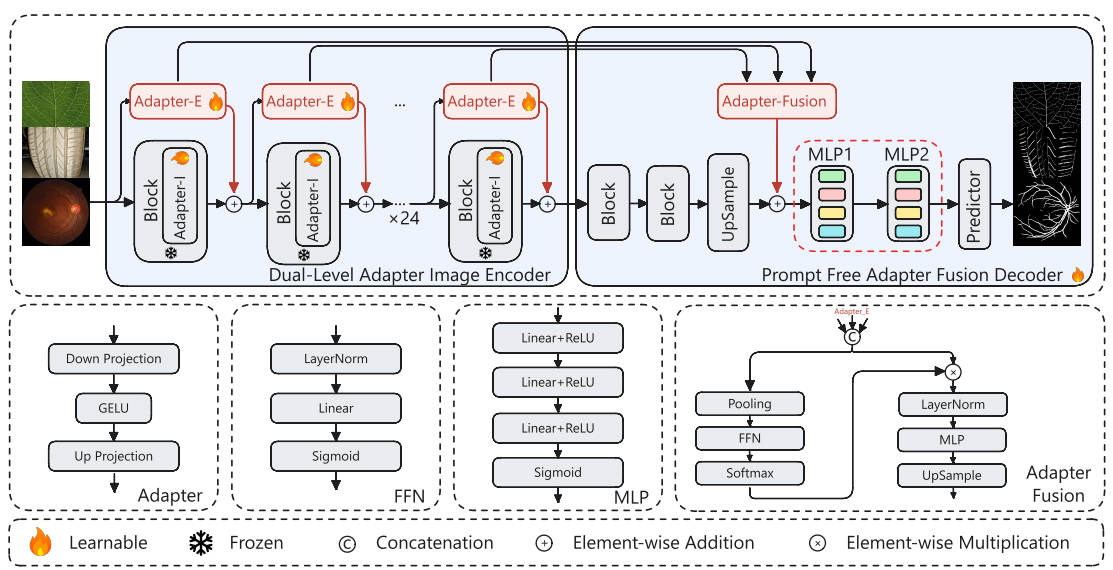
在 SAM 编码器内外加双级适配器,结合多尺度特征融合与掩码解码细化,实现免提示、少样本的曲线结构分割。
论文信息
- 论文:Dual-level Adapter Boosting Prompt-free Curvilinear Structure Segmentation
- 出处:CVPR 2026
核心痛点
曲线结构细长、边界弱、跨域差异大,现有方法依赖大量域内训练,SAM 直接用于此类任务又缺少局部和跨域适配。
模块亮点
- 块内适配器细化局部细结构;块间外部适配器聚合多层上下文,做跨域特征对齐。
- 外部适配器特征经前馈融合,掩码解码器两阶段细化拓扑与连通性。
- 免提示、只用 18 张标注图微调,在 12 个曲线数据集上取得 SOTA。
适用场景
适合视网膜血管、神经、道路、轮胎纹理等曲线结构分割,尤其是跨域、少标注场景。
插入位置建议
- 接入 SAM 的 ViT 编码器:Block 内适配器与外部适配器成对使用;接在掩码解码器前。
- 需要 SAM 预训练权重;训练时只给少量标注图,推理不需要点或框提示。
适用任务
- 曲线结构分割
- 血管/视网膜分割
- 遥感道路提取
- 跨域分割
完整代码
sacm.py
"""90_SACM_CVPR2026: 官方核心模块的单文件提取。

官方源码: https://github.com/kylechuuuuu/SACM/blob/986504957e3f41f7fc02e610e2ad9ad27c43300f/segment_anything/modeling/image_encoder.py
源码 SHA256: 0a6d1ec6c69980dacc705daf0a583fc369221a7aff2e7bf35b60ac3a5e14bba3
提取核心: AdapterModule, Attention, window_partition, window_unpartition, get_rel_pos, add_decomposed_rel_pos, Block
整理说明: 保留官方双级适配:Block 内部适配器和编码器外部归一化适配器。内联 SAM 注意力、窗口与位置编码依赖;包装类只复用原编码器已有两级调用,无需下载整个 SAM。
形状验证只说明接口可用,不代表已复现论文指标。初始化/辅助输入遵循原仓库;
需要语义特征、掩码、时间等条件的模块不能省略对应条件。
"""
from __future__ import annotations
# Copyright (c) Meta Platforms, Inc. and affiliates.
# All rights reserved.
# This source code is licensed under the license found in the
# LICENSE file in the root directory of this source tree.
# This class and its supporting functions below lightly adapted from the ViTDet backbone available at: https://github.com/facebookresearch/detectron2/blob/main/detectron2/modeling/backbone/vit.py # noqa
import torch
from torch import nn
import torch.nn.functional as F
from typing import Type,Optional,Tuple


class MLPBlock(nn.Module):

    def __init__(self, embedding_dim: int, mlp_dim: int, act: Type[nn.Module]=nn.GELU) -> None:
        super().__init__()
        self.lin1 = nn.Linear(embedding_dim, mlp_dim)
        self.lin2 = nn.Linear(mlp_dim, embedding_dim)
        self.act = act()

    def forward(self, x: torch.Tensor) -> torch.Tensor:
        return self.lin2(self.act(self.lin1(x)))


class AdapterModule(nn.Module):
    """Adapter module for efficient fine-tuning."""

    def __init__(self, dim: int, adapter_dim_ratio: float=0.1, act_layer: Type[nn.Module]=nn.GELU):
        """
        Args:
            dim (int): Number of input channels.
            adapter_dim_ratio (float): Ratio of adapter dim to embedding dim.
            act_layer (nn.Module): Activation layer.
        """
        super().__init__()
        self.adapter_dim = int(dim * adapter_dim_ratio)
        self.down_proj = nn.Linear(dim, self.adapter_dim)
        self.act = act_layer()
        self.up_proj = nn.Linear(self.adapter_dim, dim)
        nn.init.zeros_(self.up_proj.weight)
        nn.init.zeros_(self.up_proj.bias)

    def forward(self, x: torch.Tensor) -> torch.Tensor:
        return self.up_proj(self.act(self.down_proj(x)))


class Attention(nn.Module):
    """Multi-head Attention block with relative position embeddings."""

    def __init__(self, dim: int, num_heads: int=8, qkv_bias: bool=True, use_rel_pos: bool=False, rel_pos_zero_init: bool=True, input_size: Optional[Tuple[int, int]]=None) -> None:
        """
        Args:
            dim (int): Number of input channels.
            num_heads (int): Number of attention heads.
            qkv_bias (bool):  If True, add a learnable bias to query, key, value.
            rel_pos (bool): If True, add relative positional embeddings to the attention map.
            rel_pos_zero_init (bool): If True, zero initialize relative positional parameters.
            input_size (tuple(int, int) or None): Input resolution for calculating the relative
                positional parameter size.
        """
        super().__init__()
        self.num_heads = num_heads
        head_dim = dim // num_heads
        self.scale = head_dim ** (-0.5)
        self.qkv = nn.Linear(dim, dim * 3, bias=qkv_bias)
        self.proj = nn.Linear(dim, dim)
        self.use_rel_pos = use_rel_pos
        if self.use_rel_pos:
            assert input_size is not None, 'Input size must be provided if using relative positional encoding.'
            self.rel_pos_h = nn.Parameter(torch.zeros(2 * input_size[0] - 1, head_dim))
            self.rel_pos_w = nn.Parameter(torch.zeros(2 * input_size[1] - 1, head_dim))

    def forward(self, x: torch.Tensor) -> torch.Tensor:
        B, H, W, _ = x.shape
        qkv = self.qkv(x).reshape(B, H * W, 3, self.num_heads, -1).permute(2, 0, 3, 1, 4)
        q, k, v = qkv.reshape(3, B * self.num_heads, H * W, -1).unbind(0)
        attn = q * self.scale @ k.transpose(-2, -1)
        if self.use_rel_pos:
            attn = add_decomposed_rel_pos(attn, q, self.rel_pos_h, self.rel_pos_w, (H, W), (H, W))
        attn = attn.softmax(dim=-1)
        x = (attn @ v).view(B, self.num_heads, H, W, -1).permute(0, 2, 3, 1, 4).reshape(B, H, W, -1)
        x = self.proj(x)
        return x


def window_partition(x: torch.Tensor, window_size: int) -> Tuple[torch.Tensor, Tuple[int, int]]:
    """
    Partition into non-overlapping windows with padding if needed.
    Args:
        x (tensor): input tokens with [B, H, W, C].
        window_size (int): window size.

    Returns:
        windows: windows after partition with [B * num_windows, window_size, window_size, C].
        (Hp, Wp): padded height and width before partition
    """
    B, H, W, C = x.shape
    pad_h = (window_size - H % window_size) % window_size
    pad_w = (window_size - W % window_size) % window_size
    if pad_h > 0 or pad_w > 0:
        x = F.pad(x, (0, 0, 0, pad_w, 0, pad_h))
    Hp, Wp = (H + pad_h, W + pad_w)
    x = x.view(B, Hp // window_size, window_size, Wp // window_size, window_size, C)
    windows = x.permute(0, 1, 3, 2, 4, 5).contiguous().view(-1, window_size, window_size, C)
    return (windows, (Hp, Wp))


def window_unpartition(windows: torch.Tensor, window_size: int, pad_hw: Tuple[int, int], hw: Tuple[int, int]) -> torch.Tensor:
    """
    Window unpartition into original sequences and removing padding.
    Args:
        windows (tensor): input tokens with [B * num_windows, window_size, window_size, C].
        window_size (int): window size.
        pad_hw (Tuple): padded height and width (Hp, Wp).
        hw (Tuple): original height and width (H, W) before padding.

    Returns:
        x: unpartitioned sequences with [B, H, W, C].
    """
    Hp, Wp = pad_hw
    H, W = hw
    B = windows.shape[0] // (Hp * Wp // window_size // window_size)
    x = windows.view(B, Hp // window_size, Wp // window_size, window_size, window_size, -1)
    x = x.permute(0, 1, 3, 2, 4, 5).contiguous().view(B, Hp, Wp, -1)
    if Hp > H or Wp > W:
        x = x[:, :H, :W, :].contiguous()
    return x


def get_rel_pos(q_size: int, k_size: int, rel_pos: torch.Tensor) -> torch.Tensor:
    """
    Get relative positional embeddings according to the relative positions of
        query and key sizes.
    Args:
        q_size (int): size of query q.
        k_size (int): size of key k.
        rel_pos (Tensor): relative position embeddings (L, C).

    Returns:
        Extracted positional embeddings according to relative positions.
    """
    max_rel_dist = int(2 * max(q_size, k_size) - 1)
    if rel_pos.shape[0] != max_rel_dist:
        rel_pos_resized = F.interpolate(rel_pos.reshape(1, rel_pos.shape[0], -1).permute(0, 2, 1), size=max_rel_dist, mode='linear')
        rel_pos_resized = rel_pos_resized.reshape(-1, max_rel_dist).permute(1, 0)
    else:
        rel_pos_resized = rel_pos
    q_coords = torch.arange(q_size)[:, None] * max(k_size / q_size, 1.0)
    k_coords = torch.arange(k_size)[None, :] * max(q_size / k_size, 1.0)
    relative_coords = q_coords - k_coords + (k_size - 1) * max(q_size / k_size, 1.0)
    return rel_pos_resized[relative_coords.long()]


def add_decomposed_rel_pos(attn: torch.Tensor, q: torch.Tensor, rel_pos_h: torch.Tensor, rel_pos_w: torch.Tensor, q_size: Tuple[int, int], k_size: Tuple[int, int]) -> torch.Tensor:
    """
    Calculate decomposed Relative Positional Embeddings from :paper:`mvitv2`.
    https://github.com/facebookresearch/mvit/blob/19786631e330df9f3622e5402b4a419a263a2c80/mvit/models/attention.py   # noqa B950
    Args:
        attn (Tensor): attention map.
        q (Tensor): query q in the attention layer with shape (B, q_h * q_w, C).
        rel_pos_h (Tensor): relative position embeddings (Lh, C) for height axis.
        rel_pos_w (Tensor): relative position embeddings (Lw, C) for width axis.
        q_size (Tuple): spatial sequence size of query q with (q_h, q_w).
        k_size (Tuple): spatial sequence size of key k with (k_h, k_w).

    Returns:
        attn (Tensor): attention map with added relative positional embeddings.
    """
    q_h, q_w = q_size
    k_h, k_w = k_size
    Rh = get_rel_pos(q_h, k_h, rel_pos_h)
    Rw = get_rel_pos(q_w, k_w, rel_pos_w)
    B, _, dim = q.shape
    r_q = q.reshape(B, q_h, q_w, dim)
    rel_h = torch.einsum('bhwc,hkc->bhwk', r_q, Rh)
    rel_w = torch.einsum('bhwc,wkc->bhwk', r_q, Rw)
    attn = (attn.view(B, q_h, q_w, k_h, k_w) + rel_h[:, :, :, :, None] + rel_w[:, :, :, None, :]).view(B, q_h * q_w, k_h * k_w)
    return attn


class Block(nn.Module):
    """Transformer blocks with support of window attention and residual propagation blocks"""

    def __init__(self, dim: int, num_heads: int, mlp_ratio: float=4.0, qkv_bias: bool=True, norm_layer: Type[nn.Module]=nn.LayerNorm, act_layer: Type[nn.Module]=nn.GELU, use_rel_pos: bool=False, rel_pos_zero_init: bool=True, window_size: int=0, input_size: Optional[Tuple[int, int]]=None, use_adapter: bool=False, adapter_dim_ratio: float=0.1) -> None:
        """
        Args:
            dim (int): Number of input channels.
            num_heads (int): Number of attention heads in each ViT block.
            mlp_ratio (float): Ratio of mlp hidden dim to embedding dim.
            qkv_bias (bool): If True, add a learnable bias to query, key, value.
            norm_layer (nn.Module): Normalization layer.
            act_layer (nn.Module): Activation layer.
            use_rel_pos (bool): If True, add relative positional embeddings to the attention map.
            rel_pos_zero_init (bool): If True, zero initialize relative positional parameters.
            window_size (int): Window size for window attention blocks. If it equals 0, then
                use global attention.
            input_size (tuple(int, int) or None): Input resolution for calculating the relative
                positional parameter size.
            use_adapter (bool): If True, use adapter module after MLP in residual path.
            adapter_dim_ratio (float): Ratio of adapter dim to embedding dim.
        """
        super().__init__()
        self.norm1 = norm_layer(dim)
        self.attn = Attention(dim, num_heads=num_heads, qkv_bias=qkv_bias, use_rel_pos=use_rel_pos, rel_pos_zero_init=rel_pos_zero_init, input_size=input_size if window_size == 0 else (window_size, window_size))
        self.norm2 = norm_layer(dim)
        self.mlp = MLPBlock(embedding_dim=dim, mlp_dim=int(dim * mlp_ratio), act=act_layer)
        self.use_adapter = use_adapter
        if use_adapter:
            self.adapter = AdapterModule(dim, adapter_dim_ratio, act_layer)
        self.window_size = window_size

    def forward(self, x: torch.Tensor) -> torch.Tensor:
        shortcut = x
        x = self.norm1(x)
        if self.window_size > 0:
            H, W = (x.shape[1], x.shape[2])
            x, pad_hw = window_partition(x, self.window_size)
        x = self.attn(x)
        if self.window_size > 0:
            x = window_unpartition(x, self.window_size, pad_hw, (H, W))
        x = shortcut + x
        mlp_output = self.mlp(self.norm2(x))
        if self.use_adapter:
            adapter_output = self.adapter(self.norm2(x))
            x = x + mlp_output + adapter_output
        else:
            x = x + mlp_output
        return x
class DualLevelAdapterBlock(nn.Module):
    """复用官方 Block 内部适配器和 ImageEncoderViT 外部适配器调用。"""
    def __init__(self, dim, num_heads=4, adapter_dim_ratio=0.25):
        super().__init__()
        self.block = Block(dim, num_heads, use_adapter=True, adapter_dim_ratio=adapter_dim_ratio)
        self.adapter_norm = nn.LayerNorm(dim)
        self.external_adapter = AdapterModule(dim, adapter_dim_ratio)

    def forward(self, x):
        x = self.block(x)
        return x + self.external_adapter(self.adapter_norm(x))


def main():
    """最小使用示例:创建模块,验证输入与输出形状。"""
    torch.manual_seed(0)
    module = DualLevelAdapterBlock(32)
    input = torch.randn(2,8,8,32)
    output = module(input)
    assert input.shape == output.shape, (input.shape, output.shape)
    assert torch.isfinite(output).all(), "output contains NaN/Inf"
    print("input shape:", tuple(input.shape))
    print("output shape:", tuple(output.shape))
    return module, input, output


if __name__ == "__main__":
    main()
环境与依赖
Python 3.9+
继续浏览
下一篇CLASS 类别引导视觉把视觉 Token 编码到适配空间,将多模态类别原型投影成条件 Token,用交叉注意力补进稀有对象的语义信息,再经归一化、前馈细化和解码回到原视觉维度。主 VLM 保持冻结,只训练这个旁路适配器。相关资源
模块2026-11-20
IQPIR 图像质量先验条件模块
分数即条件,免改结构:用预训练 NR-IQA 模型给图像打质量分,分数离散化后经 Embedding 变成与特征图同尺寸的向量相加,再送入码预测 Transformer;推理时把分数拉满即输出最高感知质量,无需改结构
计算机视觉图像复原IQPIR
计算机视觉MIT
模块2026-11-20
ReMoE 区域感知混合专家模块
三粒度专家互补:全局专家聚合整图上下文,中心专家专注中央区域,区域专家各管一块空间分区,直接替换 ViT 块里的标准 FFN,补上区域级归纳偏置
计算机视觉对抗鲁棒性ReMoE
计算机视觉MIT
模块2026-11-20
SAM 跳跃注意力模块
窗口交叉注意力:Q 来自解码器像素查询,K、V 来自同尺度编码器特征,在 7×7 窗口内做交叉注意力并叠加相对位置偏置,把长程语义注入高分辨率特征,计算代价可控
计算机视觉单目深度估计SAM
计算机视觉MIT