模块更新于 2026-11-20· 浏览 0· 下载 0
PConv 部分卷积
省算又省访存:只对前一段连续通道(典型 1/4)做常规 3×3 卷积,其余直通;r = 1/4 时 FLOPs 仅为常规卷积的 1/16,访存约为 1/4
结构图
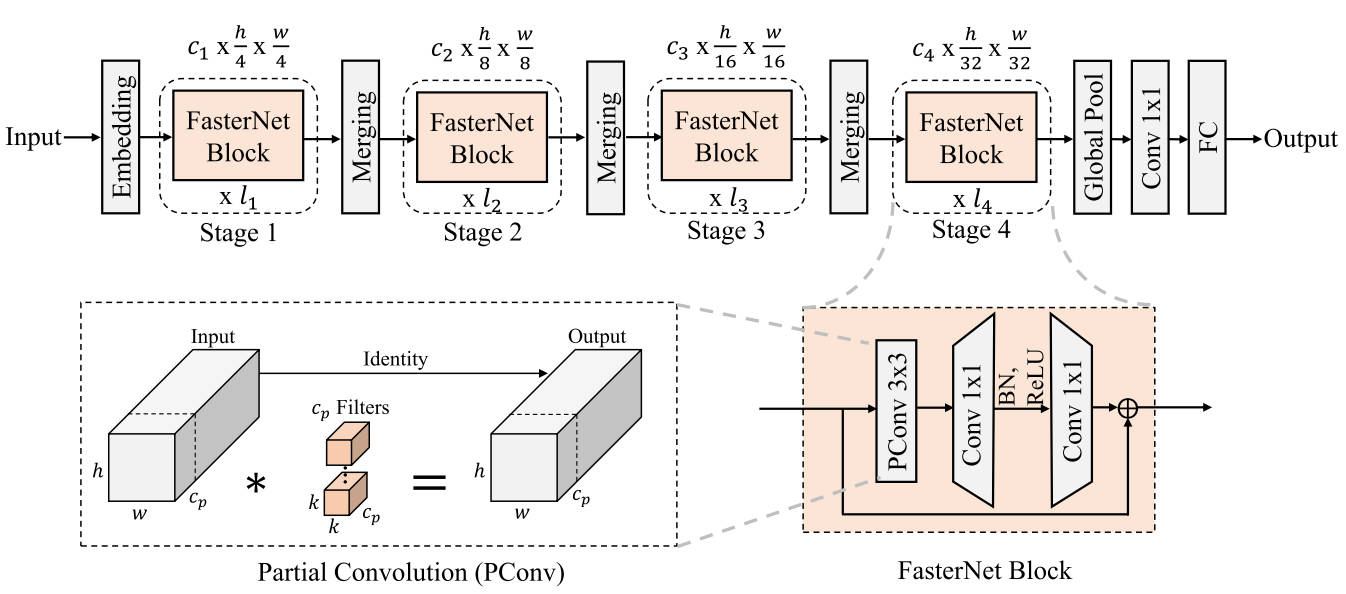
省算又省访存:只对前一段连续通道(典型 1/4)做常规 3×3 卷积,其余直通;r = 1/4 时 FLOPs 仅为常规卷积的 1/16,访存约为 1/4
论文信息
- 论文:Run, Don’t Walk: Chasing Higher FLOPS for Faster Neural Networks
- 出处:arXiv 2023
核心痛点
轻量网络都在降 FLOPs,但延迟 = FLOPs / FLOPS:DWConv / GConv 访存频繁,有效 FLOPS 甚至不如 ResNet50,CycleMLP-B1 只有一半 FLOPs,CPU 上反而更慢(116.1ms vs 73.0ms)。
模块亮点
- 省算又省访存:只对前一段连续通道(典型 1/4)做常规 3×3 卷积,其余直通;r = 1/4 时 FLOPs 仅为常规卷积的 1/16,访存约为 1/4
- 有效算力拉满:FLOPS 比 DWConv 在 GPU / CPU / ARM 上高 10.5×、6.2×、22.8×;后接 PWConv 平均测试损失仅 0.0123
- 整体模型提速:FasterNet 的 T0 比 MobileViT-XXS 在 GPU / CPU / ARM 上快 2.8× / 3.3× / 2.4×,精度高 2.9%;FasterNet-L 达 83.5% top-1
适用场景
领域为轻量级网络 / 模型加速;原文验证了 ImageNet-1k 分类、COCO 目标检测与实例分割;也适合用 DWConv / GConv 的模型,如 MobileNet、MobileViT。
插入位置建议
- 替换 MobileNet、ConvNeXt 等网络的 DWConv 层
- 后接两层 1×1 PWConv,组成 FasterNet Block
- 放进 ViT / MLP 混合模型中 DWConv 的位置,如 MobileViT
适用任务
- 轻量级网络
- 模型加速
完整代码
pconv.py
from torch import nn
import torch


class Partial_conv3(nn.Module):

    def __init__(self, dim, n_div, forward):
        super().__init__()
        self.dim_conv3 = dim // n_div
        self.dim_untouched = dim - self.dim_conv3
        self.partial_conv3 = nn.Conv2d(self.dim_conv3, self.dim_conv3, 3, 1, 1, bias=False)

        if forward == 'slicing':
            self.forward = self.forward_slicing
        elif forward == 'split_cat':
            self.forward = self.forward_split_cat
        else:
            raise NotImplementedError

    def forward_slicing(self, x):
        # only for inference
        x = x.clone()  # !!! Keep the original input intact for the residual connection later
        x[:, :self.dim_conv3, :, :] = self.partial_conv3(x[:, :self.dim_conv3, :, :])

        return x

    def forward_split_cat(self, x):
        # for training/inference
        x1, x2 = torch.split(x, [self.dim_conv3, self.dim_untouched], dim=1)
        x1 = self.partial_conv3(x1)
        x = torch.cat((x1, x2), 1)

        return x


if __name__ == '__main__':
    block = Partial_conv3(128, 2, 'split_cat')
    input = torch.rand(32, 128, 64, 64)
    output = block(input)
    print(input.size())
    print(output.size())
环境与依赖
Python 3.9+
继续浏览
下一篇PDM 历史可分解混合先分解、再分向混合:过去序列先经平均池化下采样成多尺度,再逐尺度分解出季节项和趋势项,季节项自底向上由细到粗混合,趋势项自顶向下由粗到细混合,两类信息各走各的聚合路径相关资源
模块2026-11-20
MCA 多维协同注意力
三分支三维协同:通道分支管"注意什么",高、宽分支管"注意哪里",三支输出平均融合;三支全开达 94.78%(CIFAR-10,ResNet-56)
计算机视觉图像识别MCA
计算机视觉MIT
模块2026-11-20
PConv 风车形卷积
卷积核转成风车:四路不对称 padding 配 1×k、k×1 卷积向外发散,拼接融合后感受野由中心向外递减、形似高斯分布,天然贴合红外小目标特性
计算机视觉红外小目标检测PConv
计算机视觉MIT
模块2026-11-20
SHSA 单头自注意力
单头+部分通道:只对默认 1/4.67 的输入通道做单头自注意力(QK 维度默认 16),其余通道原样直通,输出投影再覆盖全部通道,把冗余多头沿块轴串行摊开,从结构上杜绝头冗余
计算机视觉SHSA注意力机制
计算机视觉MIT