模块更新于 2026-11-20· 浏览 1· 下载 0
GRSA 分组残差自注意力
GRL 分组残差层:把 QKV 线性层按通道对半拆成两个带残差的小线性层,参数和 MACs 直接减半;消融中自注意力参数量减少 47%、MACs 减少 43%
结构图
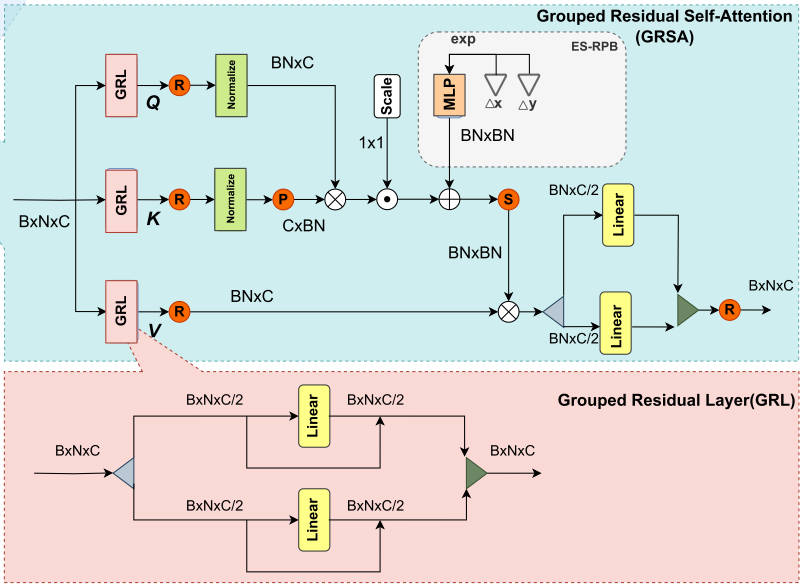
GRL 分组残差层:把 QKV 线性层按通道对半拆成两个带残差的小线性层,参数和 MACs 直接减半;消融中自注意力参数量减少 47%、MACs 减少 43%
论文信息
- 论文:GRFormer: Grouped Residual Self-Attention for Lightweight Single Image Super-Resolution
- 出处:ACM MM 2024
核心痛点
Transformer 类超分模型(如 SwinIR)自注意力参数量和计算量太大,轻量化又常带来性能下降;QKV 线性层存在冗余,原始相对位置偏置(RPB)参数量随窗口尺寸平方增长(16×16 窗口要 961 个参数),且体现不了"近处像素更重要"的直觉。
模块亮点
- GRL 分组残差层:把 QKV 线性层按通道对半拆成两个带残差的小线性层,参数和 MACs 直接减半;消融中自注意力参数量减少 47%、MACs 减少 43%
- ES-RPB 指数位置偏置:相对坐标先经指数映射再送入小 MLP 生成偏置,把"近像素权重更大"写进结构里;16×16 窗口参数从 961 降到 384,比 SwinIR 的 RPB 在 Urban100 上高 0.44 dB
- 轻量还涨点:GRFormer 在 ×2 任务 Urban100 上达到 33.17 dB,比此前 SOTA 轻量模型高 0.23 dB;整体参数量比 SwinIR 约降 20%
适用场景
领域为轻量级单图像超分辨率,原文在 Set5、Set14、B100、Urban100、Manga109 上验证了 ×2 / ×3 / ×4 超分;也可迁移到去噪、去雨等窗口自注意力复原网络。
插入位置建议
- 替换 SwinIR、SRFormer 等网络中的 W-MSA / SW-MSA 模块及其变体
- 只把原有相对位置偏置表换成 ES-RPB,注意力主体不动
- 按原文组成"GRSA + FFN"残差块堆叠使用
适用任务
- 轻量级单图像超分辨率
- 原文在 Set5
- Set14
完整代码
grsa.py
import torch
import torch.nn as nn
import numpy as np

import torch.nn.functional as F

torch.set_printoptions(threshold=np.inf)

"""《GRFormer: Grouped Residual Self-Attention for Lightweight Single Image Super-Resolution》ACM MM2024
先前的研究表明,减少基于 Transformer 的单图像超分辨率 (SISR) 模型(例如 SwinIR)的参数开销和计算量通常会导致性能下降。
在本文中,我们提出了一种高效、轻量级的方法 GRFormer,它不仅可以减少参数开销和计算量,而且可以大大提高性能。GRFormer 的核心是分组残差自注意力 (Grouped Residual Self-Attention, GRSA),它专门面向两个基本组件。
首先,它引入了一个新颖的分组残差层 (GRL) 来替换自注意力中的查询、键、值 (QKV) 线性层,旨在同时有效地减少参数开销、计算量和性能损失。
其次,它集成了一个紧凑的指数空间相对位置偏差 (ES-RPB) 来替代原始的相对位置偏差,以提高表示位置信息的能力,同时进一步最小化参数数量。
大量实验结果表明,GRFormer 在 ×2、×3 和 ×4 SISR 任务中的表现均优于目前最先进的基于 Transformer 的方法,尤其是在 DIV2K 数据集上训练时,其峰值信噪比 (PSNR) 最高可比 SOTA 高出 0.23dB,
同时仅在自注意力模块中,参数数量和 MAC 数量分别减少了约60%和49%。我们希望我们简单有效的方法能够轻松应用于基于窗口划分自注意力的 SR 模型,并成为进一步研究图像超分辨率的有用工具。
"""
class GRSA(nn.Module):
    def __init__(self, dim, window_size, num_heads, qkv_bias=True, qk_scale=None, attn_drop=0., proj_drop=0.):

        super().__init__()
        self.dim = dim
        self.window_size = window_size
        self.qkv_bias = qkv_bias
        self.num_heads = num_heads
        head_dim = dim // num_heads
        # self.scale = qk_scale or head_dim**-0.5

        self.logit_scale = nn.Parameter(torch.log(10 * torch.ones((num_heads, 1, 1))), requires_grad=True)
        # mlp to generate continuous relative position bias
        self.ESRPB_MLP = nn.Sequential(nn.Linear(2, 128, bias=True),
                                     nn.ReLU(inplace=True),
                                     nn.Linear(128, num_heads, bias=False))
        # 生成相对坐标表(relative_coords_table)
        relative_coords_h = torch.arange(-(self.window_size[0] - 1), self.window_size[0], dtype=torch.float32)
        relative_coords_w = torch.arange(-(self.window_size[1] - 1), self.window_size[1], dtype=torch.float32)
        relative_position_bias_table = torch.stack(
            torch.meshgrid([relative_coords_h,
                            relative_coords_w])).permute(1, 2, 0).contiguous().unsqueeze(0)  # 1, 2*Wh-1, 2*Ww-1, 2
        relative_position_bias_table[:, :, :, 0] /= (self.window_size[0] - 1)
        relative_position_bias_table[:, :, :, 1] /= (self.window_size[1] - 1)
        relative_position_bias_table *= 3.2  # normalize to -3.2, 3.2
        relative_position_bias_table = torch.sign(relative_position_bias_table) * (1 - torch.exp(
            -torch.abs(relative_position_bias_table)))
        self.register_buffer("relative_position_bias_table", relative_position_bias_table)

        # get pair-wise aligned relative position index for each token inside the window
        coords_h = torch.arange(self.window_size[0])
        coords_w = torch.arange(self.window_size[1])
        coords = torch.stack(torch.meshgrid([coords_h, coords_w]))  # 2, Wh, Ww
        coords_flatten = torch.flatten(coords, 1)  # 2, Wh*Ww
        relative_coords = coords_flatten[:, :, None] - coords_flatten[:, None, :]  # 2, Wh*Ww, Wh*Ww
        relative_coords = relative_coords.permute(1, 2, 0).contiguous()  # Wh*Ww, Wh*Ww, 2
        relative_coords[:, :, 0] += self.window_size[0] - 1  # shift to start from 0
        relative_coords[:, :, 1] += self.window_size[1] - 1
        relative_coords[:, :, 0] *= 2 * self.window_size[1] - 1
        relative_position_index = relative_coords.sum(-1)  # Wh*Ww, Wh*Ww
        self.register_buffer('relative_position_index', relative_position_index)
        self.q1, self.q2 = nn.Linear(dim//2, dim//2, bias=True), nn.Linear(dim//2, dim//2, bias=True)
        self.k1, self.k2 = nn.Linear(dim//2, dim//2, bias=True), nn.Linear(dim//2, dim//2, bias=True)
        self.v1, self.v2 = nn.Linear(dim//2, dim//2, bias=True), nn.Linear(dim//2, dim//2, bias=True)
        self.attn_drop = nn.Dropout(attn_drop)

        self.proj1, self.proj2 = nn.Linear(dim//2, dim//2, bias=True), nn.Linear(dim//2, dim//2, bias=True)
        self.proj_drop = nn.Dropout(proj_drop)
        self.softmax = nn.Softmax(dim=-1)

    def forward(self, x, mask=None):
        b_, n, c = x.shape
        x = x.reshape(x.shape[0], x.shape[1], 2, c // 2).permute(2, 0, 1, 3).contiguous()

        # GRL_k
        k = torch.stack((x[0] + self.k1(x[0]), x[1] + self.k2(x[1])), dim=0)
        k = k.permute(1, 2, 0, 3).flatten(2)
        k = k.reshape(b_, n, self.num_heads, c // self.num_heads).permute(0, 2, 1, 3).contiguous()

        # GRL_q
        q = torch.stack((x[0] + self.q1(x[0]), x[1] + self.q2(x[1])), dim=0)
        q = q.permute(1, 2, 0, 3).flatten(2)
        q = q.reshape(b_, n, self.num_heads, c // self.num_heads).permute(0, 2, 1, 3).contiguous()

        # GRL_v
        v = torch.stack((x[0] + self.v1(x[0]), x[1] + self.v2(x[1])), dim=0)
        v = v.permute(1, 2, 0, 3).flatten(2)
        v = v.reshape(b_, n, self.num_heads, c // self.num_heads).permute(0, 2, 1, 3).contiguous()

        # cosine attention
        attn = (F.normalize(q, dim=-1) @ F.normalize(k, dim=-1).transpose(-2, -1))

        max_logit = torch.log(torch.tensor(1. / 0.01, device=self.logit_scale.device))
        logit_scale = torch.clamp(self.logit_scale, max=max_logit).exp()
        attn = attn * logit_scale

        # 从MLP获取相对位置偏置
        relative_position_bias_table = self.ESRPB_MLP(self.relative_position_bias_table).view(-1, self.num_heads)
        relative_position_bias = relative_position_bias_table[self.relative_position_index.view(-1)].view(
            n, n, -1)  # nH, Wh*Ww, Wh*Ww
        relative_position_bias = relative_position_bias.permute(2, 0, 1).contiguous()
        relative_position_bias = 16 * torch.sigmoid(relative_position_bias)  # 缩放偏置范围

        # 将ES-RPB加到注意力权重上
        attn = attn + relative_position_bias.unsqueeze(0)

        if mask is not None:
            nw = mask.shape[0]
            attn = attn.view(b_ // nw, nw, self.num_heads, n, n) + mask.unsqueeze(1).unsqueeze(0)
            attn = attn.view(-1, self.num_heads, n, n)
        attn = self.softmax(attn)

        x = (attn @ v).transpose(1, 2).reshape(b_, n, c)
        x = x.reshape(b_, n, 2, c // 2).permute(2, 0, 1, 3).contiguous()
        x = torch.stack((self.proj1(x[0]), self.proj2(x[1])), dim=0).permute(1, 2, 0, 3).reshape(b_, n, c)
        return x


if __name__ == '__main__':
    batch_size = 4
    num_patches = 16  # 假设是4x4的patch
    embed_dim = 64

    grsa = GRSA(dim=embed_dim, window_size=(4, 4), num_heads=4).to('cuda')

    input_tensor = torch.randn(batch_size, num_patches, embed_dim).to('cuda')

    output = grsa(input_tensor)

    print(input_tensor.size())
    print(output.size())
环境与依赖
Python 3.9+
继续浏览
下一篇GSA 几何自注意力免编码用深度:深度图不经神经网络编码,平均池化对齐到各阶段,把深度距离和空间曼哈顿距离用可学习记忆权重融合成几何先验 G,再以 β^G 衰减项调制注意力权重,几何相近的 token 被增强相关资源
模块2026-11-20
HSPA 高相似性传递注意力
软阈值高通筛选:用软阈值操作替代 softmax,按相似度向量动态算出阈值,低于阈值的权重截断为 0、其余平移,只有高相似区域能"通过",无需手调
计算机视觉图像超分辨率HSPA
计算机视觉MIT
模块2026-11-20
RG-SA 递归泛化自注意力
递归泛化聚全局:RGM 仅用一个带步长的深度卷积递归复用(次数随输入尺寸动态确定),把任意分辨率特征逐级压缩成固定小尺寸的"代表特征图";再用输入特征与代表图做交叉注意力,每个 token 直达全局感受野
计算机视觉图像超分辨率RGSA
计算机视觉MIT
模块2026-11-20
TAB 令牌聚合块
推理免聚类迭代:一套 token 中心在所有图像 token 间共享,只在训练阶段用 EMA(λ=0.999)更新,推理时一次相似度匹配即完成分组
计算机视觉图像超分辨率TAB
计算机视觉MIT