模块更新于 2026-11-20· 浏览 1· 下载 0
FreqFusion 频率感知特征融合模块
三个生成器各司其职:ALPF 生成器逐点预测空间变异低通滤波器,先平滑再上采样,压住高频扰动;偏移生成器定向重采样,用一致特征替换不一致特征;
结构图
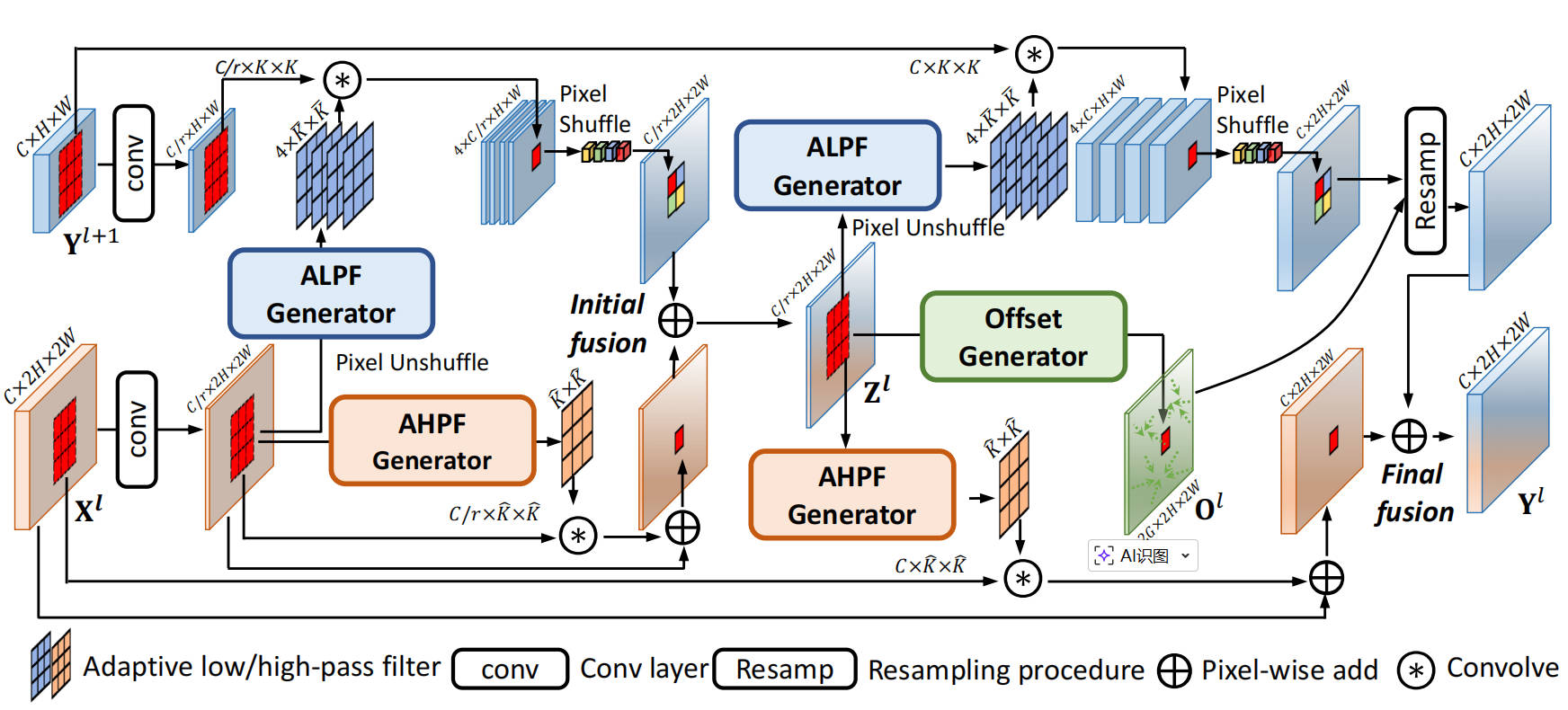
三个生成器各司其职:ALPF 生成器逐点预测空间变异低通滤波器,先平滑再上采样,压住高频扰动;偏移生成器定向重采样,用一致特征替换不一致特征;
论文信息
- 论文:Frequency-aware Feature Fusion for Dense Image Prediction
- 出处:TPAMI 2024
核心痛点
分层网络普遍用插值上采样深层粗特征再与浅层特征直接相加。物体内特征值剧烈变化(高频受扰)造成类内不一致,简单插值还会把坏特征放大成一片坏像素;边界因过度平滑而位移;低层特征的高频细节在下采样时就永久丢失。
模块亮点
- 三个生成器各司其职:ALPF 生成器逐点预测空间变异低通滤波器,先平滑再上采样,压住高频扰动;偏移生成器定向重采样,用一致特征替换不一致特征;AHPF 生成器给低层特征加自适应高通,找回丢失的高频边界。消融中去掉任一生成器都明显掉点
- 涨点显著:IntraSim 从标准融合的 0.697 提到 0.799;ADE20K 上 SegFormer-B1 提升 2.8 mIoU(41.7 到 44.5),超 CARAFE、FADE、SAPA、DySample 全部对手;MS COCO 上检测、分割也都涨点
- 代价小通用强:SegFormer-B1 上只多 0.34M 参数、2.35G FLOPs,边界 bIoU 从 27.8 涨到 32.8;CNN 和 Transformer 结构全都涨点,替换"插值 + 相加"即可用
适用场景
领域为密集图像预测;原文验证了语义分割、目标检测、实例分割、全景分割;也适合深度估计、医学影像分割等密集预测网络。
插入位置建议
- 替换 FPN / UPerNet / Mask2Former 解码器里"上采样后相加或拼接"的融合步骤
- 放在 U-Net 类网络的跳跃连接处,低分辨率特征先增强上采样再融合
- 替换 CARAFE、FADE、SAPA、DySample 等特征融合算子
适用任务
- 密集图像预测
完整代码
freqfusion.py
import torch
import torch.nn as nn
import torch.nn.functional as F
from mmcv.ops.carafe import normal_init, xavier_init, carafe
from torch.utils.checkpoint import checkpoint
import warnings
import numpy as np

"""# TPAMI 2024:Frequency-aware Feature Fusion for Dense Image Prediction
密集图像预测任务需要具有强大类别信息和高分辨率精确空间边界细节的特征。为实现此目标,现代分层模型通常利用特征融合,直接添加来自深层的上采样粗特征和来自较低层的高分辨率特征。
在本文中观察到物体内融合特征值的快速变化,由于高频特征受干扰导致类别内不一致。此外,融合特征中模糊的边界缺乏准确的高频,导致边界位移。
基于这些观察提出了频率感知特征融合(FreqFusion),集成了自适应低通滤波器(ALPF)生成器、偏移生成器和自适应高通滤波器(AHPF)生成器。
ALPF 生成器预测空间变化的低通滤波器以衰减物体内的高频分量,从而减少上采样期间的类内不一致。
偏移生成器通过重采样将不一致的特征替换为更一致的特征,从而细化较大的不一致特征和较细的边界,而 AHPF 生成器则增强了下采样过程中丢失的高频详细边界信息。
全面的可视化和定量分析表明,FreqFusion 有效地提高了特征一致性并锐化了对象边界。在各种密集预测任务中进行的大量实验证实了其有效性。
"""

def normal_init(module, mean=0, std=1, bias=0):
    if hasattr(module, 'weight') and module.weight is not None:
        nn.init.normal_(module.weight, mean, std)
    if hasattr(module, 'bias') and module.bias is not None:
        nn.init.constant_(module.bias, bias)


def constant_init(module, val, bias=0):
    if hasattr(module, 'weight') and module.weight is not None:
        nn.init.constant_(module.weight, val)
    if hasattr(module, 'bias') and module.bias is not None:
        nn.init.constant_(module.bias, bias)


def resize(input,
           size=None,
           scale_factor=None,
           mode='nearest',
           align_corners=None,
           warning=True):
    if warning:
        if size is not None and align_corners:
            input_h, input_w = tuple(int(x) for x in input.shape[2:])
            output_h, output_w = tuple(int(x) for x in size)
            if output_h > input_h or output_w > input_w:
                if ((output_h > 1 and output_w > 1 and input_h > 1
                     and input_w > 1) and (output_h - 1) % (input_h - 1)
                        and (output_w - 1) % (input_w - 1)):
                    warnings.warn(
                        f'When align_corners={align_corners}, '
                        'the output would more aligned if '
                        f'input size {(input_h, input_w)} is `x+1` and '
                        f'out size {(output_h, output_w)} is `nx+1`')
    return F.interpolate(input, size, scale_factor, mode, align_corners)


def hamming2D(M, N):
    """
    生成二维Hamming窗

    参数:
    - M:窗口的行数
    - N:窗口的列数

    返回:
    - 二维Hamming窗
    """
    # 生成水平和垂直方向上的Hamming窗
    # hamming_x = np.blackman(M)
    # hamming_x = np.kaiser(M)
    hamming_x = np.hamming(M)
    hamming_y = np.hamming(N)
    # 通过外积生成二维Hamming窗
    hamming_2d = np.outer(hamming_x, hamming_y)
    return hamming_2d


class FreqFusion(nn.Module):
    def __init__(self,
                 hr_channels,
                 lr_channels,
                 scale_factor=1,
                 lowpass_kernel=5,
                 highpass_kernel=3,
                 up_group=1,
                 encoder_kernel=3,
                 encoder_dilation=1,
                 compressed_channels=64,
                 align_corners=False,
                 upsample_mode='nearest',
                 feature_resample=False,  # use offset generator or not
                 feature_resample_group=4,
                 comp_feat_upsample=True,  # use ALPF & AHPF for init upsampling
                 use_high_pass=True,
                 use_low_pass=True,
                 hr_residual=True,
                 semi_conv=True,
                 hamming_window=True,  # for regularization, do not matter really
                 feature_resample_norm=True,
                 **kwargs):
        super().__init__()
        self.scale_factor = scale_factor
        self.lowpass_kernel = lowpass_kernel
        self.highpass_kernel = highpass_kernel
        self.up_group = up_group
        self.encoder_kernel = encoder_kernel
        self.encoder_dilation = encoder_dilation
        self.compressed_channels = compressed_channels
        self.hr_channel_compressor = nn.Conv2d(hr_channels, self.compressed_channels, 1)
        self.lr_channel_compressor = nn.Conv2d(lr_channels, self.compressed_channels, 1)
        self.content_encoder = nn.Conv2d(  # ALPF generator
            self.compressed_channels,
            lowpass_kernel ** 2 * self.up_group * self.scale_factor * self.scale_factor,
            self.encoder_kernel,
            padding=int((self.encoder_kernel - 1) * self.encoder_dilation / 2),
            dilation=self.encoder_dilation,
            groups=1)

        self.align_corners = align_corners
        self.upsample_mode = upsample_mode
        self.hr_residual = hr_residual
        self.use_high_pass = use_high_pass
        self.use_low_pass = use_low_pass
        self.semi_conv = semi_conv
        self.feature_resample = feature_resample
        self.comp_feat_upsample = comp_feat_upsample
        if self.feature_resample:
            self.dysampler = LocalSimGuidedSampler(in_channels=compressed_channels, scale=2, style='lp',
                                                   groups=feature_resample_group, use_direct_scale=True,
                                                   kernel_size=encoder_kernel, norm=feature_resample_norm)
        if self.use_high_pass:
            self.content_encoder2 = nn.Conv2d(  # AHPF generator
                self.compressed_channels,
                highpass_kernel ** 2 * self.up_group * self.scale_factor * self.scale_factor,
                self.encoder_kernel,
                padding=int((self.encoder_kernel - 1) * self.encoder_dilation / 2),
                dilation=self.encoder_dilation,
                groups=1)
        self.hamming_window = hamming_window
        lowpass_pad = 0
        highpass_pad = 0
        if self.hamming_window:
            self.register_buffer('hamming_lowpass', torch.FloatTensor(
                hamming2D(lowpass_kernel + 2 * lowpass_pad, lowpass_kernel + 2 * lowpass_pad))[None, None,])
            self.register_buffer('hamming_highpass', torch.FloatTensor(
                hamming2D(highpass_kernel + 2 * highpass_pad, highpass_kernel + 2 * highpass_pad))[None, None,])
        else:
            self.register_buffer('hamming_lowpass', torch.FloatTensor([1.0]))
            self.register_buffer('hamming_highpass', torch.FloatTensor([1.0]))
        self.init_weights()

    def init_weights(self):
        for m in self.modules():
            # print(m)
            if isinstance(m, nn.Conv2d):
                xavier_init(m, distribution='uniform')
        normal_init(self.content_encoder, std=0.001)
        if self.use_high_pass:
            normal_init(self.content_encoder2, std=0.001)

    def kernel_normalizer(self, mask, kernel, scale_factor=None, hamming=1):
        if scale_factor is not None:
            mask = F.pixel_shuffle(mask, self.scale_factor)
        n, mask_c, h, w = mask.size()
        mask_channel = int(mask_c / float(kernel ** 2))
        # mask = mask.view(n, mask_channel, -1, h, w)
        # mask = F.softmax(mask, dim=2, dtype=mask.dtype)
        # mask = mask.view(n, mask_c, h, w).contiguous()

        mask = mask.view(n, mask_channel, -1, h, w)
        mask = F.softmax(mask, dim=2, dtype=mask.dtype)
        mask = mask.view(n, mask_channel, kernel, kernel, h, w)
        mask = mask.permute(0, 1, 4, 5, 2, 3).view(n, -1, kernel, kernel)
        # mask = F.pad(mask, pad=[padding] * 4, mode=self.padding_mode) # kernel + 2 * padding
        mask = mask * hamming
        mask /= mask.sum(dim=(-1, -2), keepdims=True)
        # print(hamming)
        # print(mask.shape)
        mask = mask.view(n, mask_channel, h, w, -1)
        mask = mask.permute(0, 1, 4, 2, 3).view(n, -1, h, w).contiguous()
        return mask

    def forward(self, hr_feat, lr_feat, use_checkpoint=False):
        if use_checkpoint:
            return checkpoint(self._forward, hr_feat, lr_feat)
        else:
            return self._forward(hr_feat, lr_feat)

    def _forward(self, hr_feat, lr_feat):
        compressed_hr_feat = self.hr_channel_compressor(hr_feat)
        compressed_lr_feat = self.lr_channel_compressor(lr_feat)
        if self.semi_conv:
            if self.comp_feat_upsample:
                if self.use_high_pass:
                    mask_hr_hr_feat = self.content_encoder2(compressed_hr_feat)
                    mask_hr_init = self.kernel_normalizer(mask_hr_hr_feat, self.highpass_kernel,
                                                          hamming=self.hamming_highpass)
                    compressed_hr_feat = compressed_hr_feat + compressed_hr_feat - carafe(compressed_hr_feat,
                                                                                          mask_hr_init,
                                                                                          self.highpass_kernel,
                                                                                          self.up_group, 1)

                    mask_lr_hr_feat = self.content_encoder(compressed_hr_feat)
                    mask_lr_init = self.kernel_normalizer(mask_lr_hr_feat, self.lowpass_kernel,
                                                          hamming=self.hamming_lowpass)

                    mask_lr_lr_feat_lr = self.content_encoder(compressed_lr_feat)
                    mask_lr_lr_feat = F.interpolate(
                        carafe(mask_lr_lr_feat_lr, mask_lr_init, self.lowpass_kernel, self.up_group, 2),
                        size=compressed_hr_feat.shape[-2:], mode='nearest')
                    mask_lr = mask_lr_hr_feat + mask_lr_lr_feat

                    mask_lr_init = self.kernel_normalizer(mask_lr, self.lowpass_kernel, hamming=self.hamming_lowpass)
                    mask_hr_lr_feat = F.interpolate(
                        carafe(self.content_encoder2(compressed_lr_feat), mask_lr_init, self.lowpass_kernel,
                               self.up_group, 2), size=compressed_hr_feat.shape[-2:], mode='nearest')
                    mask_hr = mask_hr_hr_feat + mask_hr_lr_feat
                else:
                    raise NotImplementedError
            else:
                mask_lr = self.content_encoder(compressed_hr_feat) + F.interpolate(
                    self.content_encoder(compressed_lr_feat), size=compressed_hr_feat.shape[-2:], mode='nearest')
                if self.use_high_pass:
                    mask_hr = self.content_encoder2(compressed_hr_feat) + F.interpolate(
                        self.content_encoder2(compressed_lr_feat), size=compressed_hr_feat.shape[-2:], mode='nearest')
        else:
            compressed_x = F.interpolate(compressed_lr_feat, size=compressed_hr_feat.shape[-2:],
                                         mode='nearest') + compressed_hr_feat
            mask_lr = self.content_encoder(compressed_x)
            if self.use_high_pass:
                mask_hr = self.content_encoder2(compressed_x)

        mask_lr = self.kernel_normalizer(mask_lr, self.lowpass_kernel, hamming=self.hamming_lowpass)
        if self.semi_conv:
            lr_feat = carafe(lr_feat, mask_lr, self.lowpass_kernel, self.up_group, 2)
        else:
            lr_feat = resize(
                input=lr_feat,
                size=hr_feat.shape[2:],
                mode=self.upsample_mode,
                align_corners=None if self.upsample_mode == 'nearest' else self.align_corners)
            lr_feat = carafe(lr_feat, mask_lr, self.lowpass_kernel, self.up_group, 1)

        if self.use_high_pass:
            mask_hr = self.kernel_normalizer(mask_hr, self.highpass_kernel, hamming=self.hamming_highpass)
            hr_feat_hf = hr_feat - carafe(hr_feat, mask_hr, self.highpass_kernel, self.up_group, 1)
            if self.hr_residual:
                # print('using hr_residual')
                hr_feat = hr_feat_hf + hr_feat
            else:
                hr_feat = hr_feat_hf

        if self.feature_resample:
            # print(lr_feat.shape)
            lr_feat = self.dysampler(hr_x=compressed_hr_feat,
                                     lr_x=compressed_lr_feat, feat2sample=lr_feat)

        return mask_lr, hr_feat, lr_feat


class LocalSimGuidedSampler(nn.Module):
    """
    offset generator in FreqFusion
    """

    def __init__(self, in_channels, scale=2, style='lp', groups=4, use_direct_scale=True, kernel_size=1, local_window=3,
                 sim_type='cos', norm=True, direction_feat='sim_concat'):
        super().__init__()
        assert scale == 2
        assert style == 'lp'

        self.scale = scale
        self.style = style
        self.groups = groups
        self.local_window = local_window
        self.sim_type = sim_type
        self.direction_feat = direction_feat

        if style == 'pl':
            assert in_channels >= scale ** 2 and in_channels % scale ** 2 == 0
        assert in_channels >= groups and in_channels % groups == 0

        if style == 'pl':
            in_channels = in_channels // scale ** 2
            out_channels = 2 * groups
        else:
            out_channels = 2 * groups * scale ** 2
        if self.direction_feat == 'sim':
            self.offset = nn.Conv2d(local_window ** 2 - 1, out_channels, kernel_size=kernel_size,
                                    padding=kernel_size // 2)
        elif self.direction_feat == 'sim_concat':
            self.offset = nn.Conv2d(in_channels + local_window ** 2 - 1, out_channels, kernel_size=kernel_size,
                                    padding=kernel_size // 2)
        else:
            raise NotImplementedError
        normal_init(self.offset, std=0.001)
        if use_direct_scale:
            if self.direction_feat == 'sim':
                self.direct_scale = nn.Conv2d(in_channels, out_channels, kernel_size=kernel_size,
                                              padding=kernel_size // 2)
            elif self.direction_feat == 'sim_concat':
                self.direct_scale = nn.Conv2d(in_channels + local_window ** 2 - 1, out_channels,
                                              kernel_size=kernel_size, padding=kernel_size // 2)
            else:
                raise NotImplementedError
            constant_init(self.direct_scale, val=0.)

        out_channels = 2 * groups
        if self.direction_feat == 'sim':
            self.hr_offset = nn.Conv2d(local_window ** 2 - 1, out_channels, kernel_size=kernel_size,
                                       padding=kernel_size // 2)
        elif self.direction_feat == 'sim_concat':
            self.hr_offset = nn.Conv2d(in_channels + local_window ** 2 - 1, out_channels, kernel_size=kernel_size,
                                       padding=kernel_size // 2)
        else:
            raise NotImplementedError
        normal_init(self.hr_offset, std=0.001)

        if use_direct_scale:
            if self.direction_feat == 'sim':
                self.hr_direct_scale = nn.Conv2d(in_channels, out_channels, kernel_size=kernel_size,
                                                 padding=kernel_size // 2)
            elif self.direction_feat == 'sim_concat':
                self.hr_direct_scale = nn.Conv2d(in_channels + local_window ** 2 - 1, out_channels,
                                                 kernel_size=kernel_size, padding=kernel_size // 2)
            else:
                raise NotImplementedError
            constant_init(self.hr_direct_scale, val=0.)

        self.norm = norm
        if self.norm:
            self.norm_hr = nn.GroupNorm(in_channels // 8, in_channels)
            self.norm_lr = nn.GroupNorm(in_channels // 8, in_channels)
        else:
            self.norm_hr = nn.Identity()
            self.norm_lr = nn.Identity()
        self.register_buffer('init_pos', self._init_pos())

    def _init_pos(self):
        h = torch.arange((-self.scale + 1) / 2, (self.scale - 1) / 2 + 1) / self.scale
        return torch.stack(torch.meshgrid([h, h])).transpose(1, 2).repeat(1, self.groups, 1).reshape(1, -1, 1, 1)

    def sample(self, x, offset, scale=None):
        if scale is None: scale = self.scale
        B, _, H, W = offset.shape
        offset = offset.view(B, 2, -1, H, W)
        coords_h = torch.arange(H) + 0.5
        coords_w = torch.arange(W) + 0.5
        coords = torch.stack(torch.meshgrid([coords_w, coords_h])
                             ).transpose(1, 2).unsqueeze(1).unsqueeze(0).type(x.dtype).to(x.device)
        normalizer = torch.tensor([W, H], dtype=x.dtype, device=x.device).view(1, 2, 1, 1, 1)
        coords = 2 * (coords + offset) / normalizer - 1
        coords = F.pixel_shuffle(coords.view(B, -1, H, W), scale).view(
            B, 2, -1, scale * H, scale * W).permute(0, 2, 3, 4, 1).contiguous().flatten(0, 1)
        return F.grid_sample(x.reshape(B * self.groups, -1, x.size(-2), x.size(-1)), coords, mode='bilinear',
                             align_corners=False, padding_mode="border").view(B, -1, scale * H, scale * W)

    def forward(self, hr_x, lr_x, feat2sample):
        hr_x = self.norm_hr(hr_x)
        lr_x = self.norm_lr(lr_x)

        if self.direction_feat == 'sim':
            hr_sim = compute_similarity(hr_x, self.local_window, dilation=2, sim='cos')
            lr_sim = compute_similarity(lr_x, self.local_window, dilation=2, sim='cos')
        elif self.direction_feat == 'sim_concat':
            hr_sim = torch.cat([hr_x, compute_similarity(hr_x, self.local_window, dilation=2, sim='cos')], dim=1)
            lr_sim = torch.cat([lr_x, compute_similarity(lr_x, self.local_window, dilation=2, sim='cos')], dim=1)
            hr_x, lr_x = hr_sim, lr_sim
        # offset = self.get_offset(hr_x, lr_x)
        offset = self.get_offset_lp(hr_x, lr_x, hr_sim, lr_sim)
        return self.sample(feat2sample, offset)

    # def get_offset_lp(self, hr_x, lr_x):
    def get_offset_lp(self, hr_x, lr_x, hr_sim, lr_sim):
        if hasattr(self, 'direct_scale'):
            # offset = (self.offset(lr_x) + F.pixel_unshuffle(self.hr_offset(hr_x), self.scale)) * (self.direct_scale(lr_x) + F.pixel_unshuffle(self.hr_direct_scale(hr_x), self.scale)).sigmoid() + self.init_pos
            offset = (self.offset(lr_sim) + F.pixel_unshuffle(self.hr_offset(hr_sim), self.scale)) * (
                        self.direct_scale(lr_x) + F.pixel_unshuffle(self.hr_direct_scale(hr_x),
                                                                    self.scale)).sigmoid() + self.init_pos
            # offset = (self.offset(lr_sim) + F.pixel_unshuffle(self.hr_offset(hr_sim), self.scale)) * (self.direct_scale(lr_sim) + F.pixel_unshuffle(self.hr_direct_scale(hr_sim), self.scale)).sigmoid() + self.init_pos
        else:
            offset = (self.offset(lr_x) + F.pixel_unshuffle(self.hr_offset(hr_x), self.scale)) * 0.25 + self.init_pos
        return offset

    def get_offset(self, hr_x, lr_x):
        if self.style == 'pl':
            raise NotImplementedError
        return self.get_offset_lp(hr_x, lr_x)


def compute_similarity(input_tensor, k=3, dilation=1, sim='cos'):
    """
    计算输入张量中每一点与周围KxK范围内的点的余弦相似度。

    参数:
    - input_tensor: 输入张量,形状为[B, C, H, W]
    - k: 范围大小,表示周围KxK范围内的点

    返回:
    - 输出张量,形状为[B, KxK-1, H, W]
    """
    B, C, H, W = input_tensor.shape
    # 使用零填充来处理边界情况
    # padded_input = F.pad(input_tensor, (k // 2, k // 2, k // 2, k // 2), mode='constant', value=0)

    # 展平输入张量中每个点及其周围KxK范围内的点
    unfold_tensor = F.unfold(input_tensor, k, padding=(k // 2) * dilation, dilation=dilation)  # B, CxKxK, HW
    # print(unfold_tensor.shape)
    unfold_tensor = unfold_tensor.reshape(B, C, k ** 2, H, W)

    # 计算余弦相似度
    if sim == 'cos':
        similarity = F.cosine_similarity(unfold_tensor[:, :, k * k // 2:k * k // 2 + 1], unfold_tensor[:, :, :], dim=1)
    elif sim == 'dot':
        similarity = unfold_tensor[:, :, k * k // 2:k * k // 2 + 1] * unfold_tensor[:, :, :]
        similarity = similarity.sum(dim=1)
    else:
        raise NotImplementedError

    # 移除中心点的余弦相似度,得到[KxK-1]的结果
    similarity = torch.cat((similarity[:, :k * k // 2], similarity[:, k * k // 2 + 1:]), dim=1)

    # 将结果重塑回[B, KxK-1, H, W]的形状
    similarity = similarity.view(B, k * k - 1, H, W)
    return similarity


if __name__ == '__main__':
    hr_channels = 256
    lr_channels = 128
    batch_size = 2
    # (batch_size, channels, height, width)
    hr_feat = torch.randn(batch_size, hr_channels, 64, 64).cuda()  # HR特征
    lr_feat = torch.randn(batch_size, lr_channels, 32, 32).cuda()  # LR特征

    block = FreqFusion(hr_channels=256, lr_channels=128).cuda()

    mask_lr, hr_feat_out, lr_feat_out = block(hr_feat, lr_feat)

    # 打印输入输出的shape
    print("HR In:", hr_feat.shape) # torch.Size([2, 256, 64, 64])
    print("LR In:", lr_feat.shape) # torch.Size([2, 128, 32, 32])
    print("Mask LR:", mask_lr.shape) # torch.Size([2, 128, 32, 32])
    print("HR Out:", hr_feat_out.shape) # torch.Size([2, 256, 64, 64])
    print("LR Out:", lr_feat_out.shape) # torch.Size([2, 128, 64, 64])
环境与依赖
Python 3.9+
继续浏览
下一篇FreqSelect 频率选择模块分频段动态加权:按倍频程把特征分解成 4 个频段,对每个频段预测空间选择图分别重加权,压低背景与物体中心的高频、保留物体边界的高频相关资源
模块2026-11-20
FFM 特征融合模块
先对齐再减冗:1×1 卷积把 CNN 特征图与 Transformer token 序列对齐到同一维度,再用通道注意力(CA)压低冗余通道、放大互补信息
计算机视觉语义分割FFM
计算机视觉MIT
模块2026-11-20
CRA 通道缩减注意力
QK 压成一维标量:把每个注意力头中 query 和 key 的通道维嵌到一维,token 变成标量,Query-Key 计算量直接缩小 C 倍,注意力运算量约减半
计算机视觉语义分割CRA
计算机视觉MIT
模块2026-11-20
GBC 门控瓶颈卷积
低秩瓶颈省参数:BottConv 用逐点卷积把特征投影进低秩子空间,深度卷积在子空间内做空间提取后再投回,复杂度按低秩比例近似下降;替换原始卷积后参数量与计算负载大幅降低、性能影响极小
计算机视觉语义分割裂缝检测
计算机视觉MIT